

Superlok® USA · Fittings
NPT vs BSPT: Why They Look the Same and Leak Anyway
Two tapered pipe threads, the same taper, different flank angles, and at half the common sizes the same pitch. That combination is why the joint starts sweetly and weeps forever.
The reason NPT and BSPT fittings get mixed up is not carelessness. It is that they share the one feature your hands notice first. According to thread data published by Engineering ToolBox, an engineering reference publisher, NPT has a 60 degree thread angle and a taper of “1 in 16 inches,” equal to three quarters of an inch per foot, which puts the flank at 1 degree 47 minutes to the axis. The same publisher’s ISO 7 data gives British Standard Pipe Taper a “55o thread angle” with “truncation of roots and crests are rounded,” and the identical 1 degree 47 minute taper. So both are tapered, both taper at the same rate, and both are designated by the same nominal inch sizes. Everything that differs is small enough to thread past your fingertips and large enough to leak.
The flank angle is the real difference
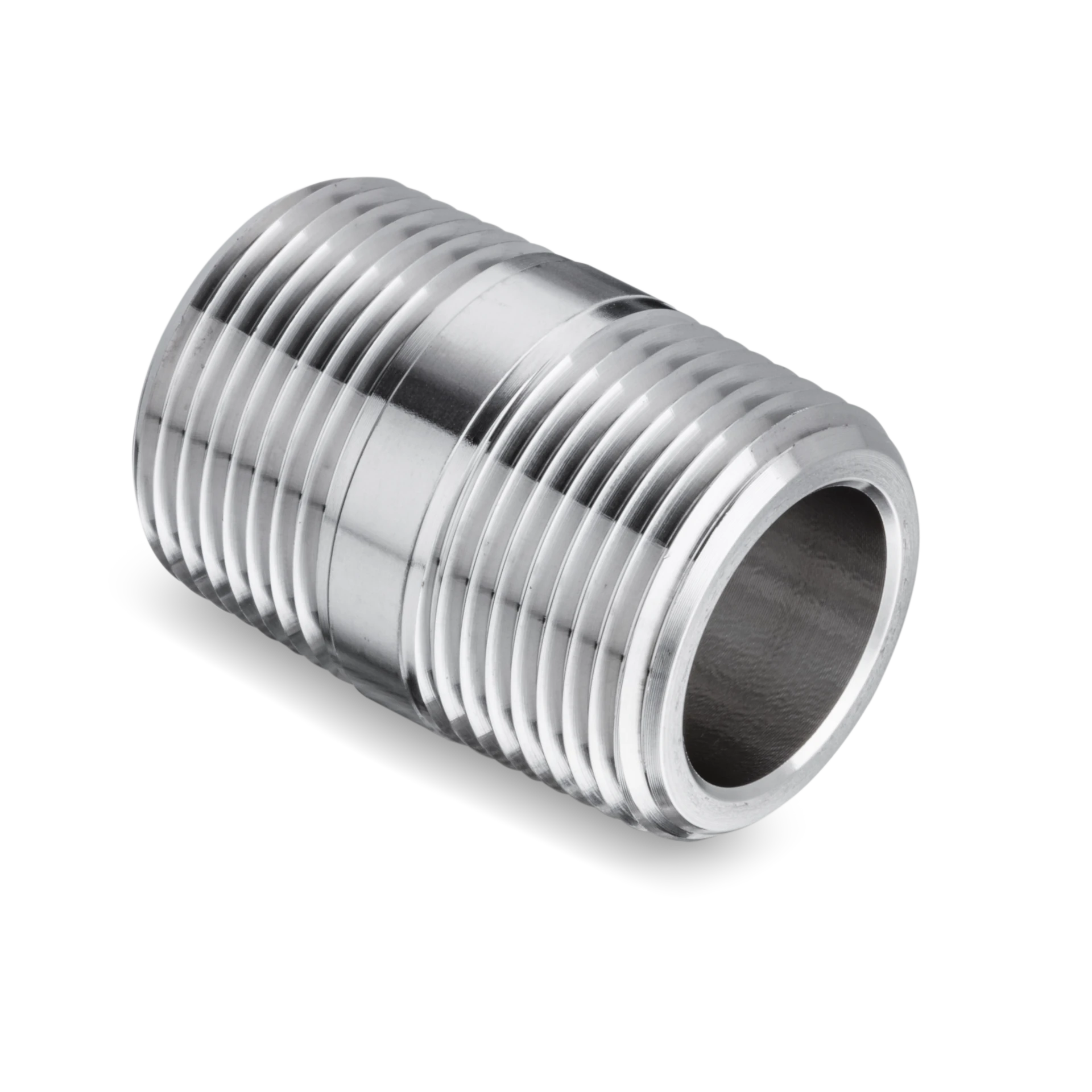
A pipe thread seals because metal deforms against metal along the flanks as the taper tightens. NPT presents a 60 degree included angle with flattened crests and roots. BSPT, which inherits the Whitworth form, presents 55 degrees with rounded crests and roots. Screw one into the other and the flanks meet along a line instead of bedding across their faces, and the rounded British crest does not fill the flat American root. You get a mechanical connection that holds the parts together, not a seal, and the helical gap left behind is a spiral leak path no amount of tape will reliably close.
Both standards expect the seal to be made on the threads, with sealant assisting rather than creating it. Sealant fills the small intended imperfections of a correctly matched pair. It does not bridge a five degree flank mismatch. Crews who get a mismatched joint to hold on the first hydrotest usually meet it again after a few thermal cycles.
Pitch: sometimes a warning, sometimes a trap
Thread pitch is where the two standards get genuinely dangerous, because they sometimes agree. Using the threads per inch published by Engineering ToolBox for both standards, the 1/8, 1/4, 3/8 and 1 inch sizes differ by one thread per inch or by half a thread. Cross those and the parts bind, gall or stop turning early, and somebody notices. But at 1/2 inch and 3/4 inch both standards use 14 threads per inch. A 1/2 inch NPT male will wind into a 1/2 inch BSPT female smoothly, take a wrench, and feel like a finished joint. It is a 60 degree thread in a 55 degree hole.
| Nominal size | NPT | BSPT | What happens if crossed |
|---|---|---|---|
| 1/8 in | 27 | 28 | Binds after a turn or two, usually caught |
| 1/4 in | 18 | 19 | Noticeably tight, often caught |
| 3/8 in | 18 | 19 | Noticeably tight, often caught |
| 1/2 in | 14 | 14 | Assembles smoothly and leaks, the worst case |
| 3/4 in | 14 | 14 | Assembles smoothly and leaks, the worst case |
| 1 in | 11 1/2 | 11 | Half a thread out, drifts and jams |
Pitch figures from published NPT and ISO 7 thread data, cited below. Thread form on any specific part is confirmed per order.
Identifying them in the field
You need three cheap checks and the discipline to do all three. First, a thread pitch gauge. Count the threads per inch and compare against the table above. If the size is 1/8, 1/4, 3/8 or 1 inch, pitch alone tells you which standard you are holding. Second, look at the crest under a loupe or good light. A flat crest points to NPT, a rounded crest points to the British form. This is the check that saves you at 1/2 and 3/4 inch, where pitch is silent. Third, read the paperwork and the stamp. An R designation is a tapered British male, Rc a tapered British female, and Rp a parallel British female, so the letters on a drawing carry the answer if anyone wrote them down.
Provenance is the fastest clue. Equipment built to American standards arrives with NPT, while equipment built to British or ISO practice arrives with BSPT or BSPP. When a skid combines both, which is normal, the answer is an adapter with the right form on each end, not a wrench and optimism. Our fitting cross-reference tool and the catalog are the place to settle the callout before parts are cut.
Three failure patterns that account for most mixed thread leaks on instrument and process piping.
The matching pitch trap
At 1/2 and 3/4 inch both standards run 14 threads per inch, so a crossed pair assembles without complaint. Nothing binds, torque feels normal, and the flank mismatch is invisible until the line is hot and pressurised. This is the failure that gets past inspection.
Forcing the mismatch
At 1/8, 1/4, 3/8 and 1 inch the pitch difference makes the parts fight. Driving through it with a long wrench cuts a hybrid thread in the softer part, which then leaks and is no longer usable with the correct mating form either. One forced joint can cost two components.
BSPP mistaken for BSPT
BSPP is parallel and shares the 55 degree form, and its joint is not made on the threads at all. It seals on a bonded washer or O-ring at the face. A BSPT male will start into a BSPP female because a tapered male fits a parallel female, so it goes together and seals on nothing.
What to put on the drawing
Name the standard, not just the size. “1/2 in NPT female” and “1/2 in BSPT female to ISO 7-1” are different parts that both answer to “half inch taper”. Where a transition is unavoidable, specify a dedicated adapter and show which end is which, and keep every transition on one documented boundary so the next person to break a joint knows what they are looking at. Superlok® pipe fittings are listed in 316 stainless steel, a corrosion-resistant grade that holds a thread form well, and thread type is confirmed per order rather than inferred from a size.
One more reason to get the callout right: surface quality. Superlok® fittings are finished to give the finest interior surface finish of any tube and pipe fitting on the market, and that effort is wasted if the joint at either end is a spiral leak path. The same goes for the tube fittings and the rest of the fitting range feeding into it. For pressure and temperature limits on the assembled joint, start from the pressure rating tables and the installation guide, and for the kind of mixed origin equipment where this problem lives, the oil and gas instrumentation notes are a useful companion.
Common questions
Can I ever use NPT and BSPT together if I use enough sealant?
No. Both standards intend the seal to be formed on the thread flanks, with sealant filling minor imperfections. A 60 degree flank in a 55 degree form leaves a continuous helical gap, which is a leak path rather than an imperfection. Use an adapter with the correct form on each end.
Why do both standards use the same taper if they are incompatible?
Historical convergence. Both settled on a taper of 1 in 16, about 1 degree 47 minutes to the axis, because it gives a workable wedge over a few turns. The thread form each standard wrapped around that taper was set separately, and that is where they part company.
Is BSP the same as BSPT?
BSP is the family. BSPT is the tapered member, designated R for a male and Rc for a tapered female. BSPP is the parallel member, with Rp used for a parallel female. Reading BSP on a drawing without a letter means the drawing is incomplete.
How do I tell 1/2 inch NPT from 1/2 inch BSPT with no gauge?
Pitch will not help you at that size, so look at the crests. Flat crests and roots indicate NPT, rounded crests and roots indicate the British Whitworth form. If you cannot see it clearly, treat the part as unknown and confirm from documentation.
Does the mismatch matter at low pressure?
It matters wherever a leak matters. Low pressure gas and analyser lines are often the least tolerant of a small continuous leak, because the consequence is a wrong reading or a hazardous accumulation rather than a visible drip.
Not sure which thread standard you are holding?
Send the size, the pitch you counted and the equipment origin, and we will confirm the callout before anything is cut.
Superlok® North America
Pipe and tube fittings listed in 316 stainless steel, thread form confirmed per order.
Sources
- Engineering ToolBox, “NPT, National Pipe Thread Taper,” engineering reference data. Supports the 60 degree NPT thread angle, the taper of 1 in 16 (three quarters of an inch per foot, 1 degree 47 minutes 24 seconds to the axis), the ANSI B1.20.1 reference and the NPT threads per inch figures. engineeringtoolbox.com
- Engineering ToolBox, “ISO 7, Pipe Threads where Pressure-tight Joints are made on the Threads,” engineering reference data. Supports the 55 degree BSPT thread angle, rounded truncation of crests and roots, the R, Rc and Rp designations and the BSPT threads per inch figures. engineeringtoolbox.com
- Machining Doctor, “British Pipe Thread (BSP): Dimensions and Formulas,” a machining reference publication. Supports the 55 degree truncated and rounded profile, the 1 degree 47 minute taper on R and Rc, the zero taper on Rp, and the distinction between joints made on the threads and joints sealed off the threads. machiningdoctor.com
- Ajax Systems Support, “Pipe threads compatibility: BSPP, BSPT, and NPT,” a manufacturer’s own support publication. Supports flat versus rounded crests, the rule that a tapered male will fit a tapered or parallel female, and the statement that “BSP and NPT threads are incompatible.” ajax.systems
Technical note: the sources cited above establish the published thread angle, taper and pitch figures for NPT and for ISO 7 tapered pipe threads, and the designations used for the British parallel and tapered forms. They do not establish what is fitted to any particular piece of equipment, and they are not a substitute for reading the governing standard or the equipment documentation. Nothing here is a specification for a Superlok® part: thread standard, grade, material and pressure rating are confirmed per order.
Trademark disclaimer: Superlok® is a registered trademark of its owner. Swagelok®, Parker® and Hy-Lok® are registered trademarks of their respective owners. No affiliation, endorsement, sponsorship or approval by those companies is claimed or implied, and nothing here states or suggests that Superlok® products are the same as, equivalent to, compatible with or a replacement for any other brand. Cross-references are made by form, fit, and function only.