

Superlok® USA · Valves
Check Valve Orientation: Flow Direction, Mounting Position and Backpressure
Some check valves work in any position. Others only work in one. Knowing which kind is in your hand matters more than the pipe spec.
Two check valves can share a line size, a pressure class and a flange pattern and still disagree about which way is up. That is not a manufacturing defect. It is a difference in how the disc or poppet gets back to its seat. According to Valve Magazine, published by the Valve Manufacturers Association of America, swing check valves “should only be installed in a horizontal flow position” because “they will not operate properly in the vertical flow positions,” while piston and poppet designs “can be installed in any position, including flow down if the proper spring is installed.” One sentence, two very different installation drawings, and a reminder that orientation is a design question before it is a piping question.
The flow arrow is the specification
Every check valve body carries a cast or stamped arrow, and it is not a suggestion. Valve Magazine states plainly that installers must “point the flow arrow in the direction of the flow to allow the valve to perform its intended function.” A valve installed backward does not fail gracefully. It either blocks the line entirely or, worse, sits held open by upstream pressure with no ability to stop reverse flow at all, which defeats the reason the valve was specified in the first place. Confirm the arrow against the process drawing before the valve goes in the line, not after start-up when the symptom shows up as flow that will not stop when a pump trips.
Why some designs tolerate any position and others do not
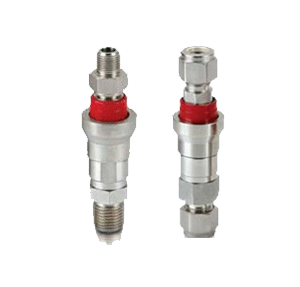
The difference comes down to what closes the poppet or disc once flow stops. A spring-loaded poppet check valve carries its own closing force built into the cartridge. Swagelok® documentation for its poppet check valve line notes that the spring design “allows valve installation in any orientation,” because the spring, not gravity, drives the poppet back to the seat regardless of which way the body is turned. That is the geometry behind Superlok® check valves, which are built as spring-loaded poppet designs for instrument and process tubing runs.
A swing check valve works differently. Its disc hangs on a hinge and falls closed under its own weight, assisted by reversing flow pushing it back onto the seat. Take gravity out of the equation, as happens in a vertical downflow line, and the disc has nothing to swing against. Parker® Hannifin literature for its gravity-assisted lift check series carries an explicit warning to the same effect: “valve must be mounted in proper orientation,” because that design also “uses back pressure to achieve a seal” rather than a spring. Two mechanisms, two installation rules, and neither one transfers to the other.
What sits downstream of a pump
A check valve at pump discharge has one job: stop the column of liquid in the discharge line from running back through the pump the instant it stops. Where that reverse push comes from is the backpressure already sitting in the line, elevation head in a vertical run, a downstream restriction, or another pump feeding the same header. Valve Magazine describes the mechanism directly: swing, tilting-disc and double-door check valves “rely on reversing flow and back pressure to push the disc back onto the seat to close the valve,” and when that reversal happens hard in a vertical line, “the disc is likely to slam with a great deal of force.”
Spring-assisted designs are built to close before that reversal builds momentum. The same article notes that silent, spring-loaded check valves “close upon the decrease of the differential pressure across the closure member of the valve as flowrate decreases, rather than closing from reverse flow.” For a header fed by more than one pump, the guidance is specific: the units “either need to be shut down slowly, or need to have in-line silent check valves installed immediately after each pump.” That is why a check valve belongs as close to the pump discharge as the layout allows, rather than somewhere further downstream where it can no longer beat the backpressure to the seat.
Orientation mistakes that show up after start-up, not before
Arrow ignored
The valve goes in reversed on a symmetrical-looking body. Nothing looks wrong until reverse flow runs straight through it.
Swing check, vertical line
A hinge-and-disc valve installed in a downflow run has no gravity to close it. It sits open, waiting for reverse flow to prove the problem.
Valve too far from the pump
Backpressure has room to build before it reaches the seat. The closure event is harder and later than the design intended.
None of this is guesswork once the design type is known. Confirm whether the valve in hand closes by spring or by gravity, install accordingly, and keep the arrow lined up with the drawing. Our installation guide covers assembly practice for the fitting side of the same line, and pressure figures by size and series are listed on our pressure rating pages.
| Closing mechanism | Published orientation | What closes it |
|---|---|---|
| Spring-loaded poppet | Any orientation, per spec | Internal spring |
| Swing (hinged disc) | Horizontal flow only | Gravity plus reversing flow |
| Gravity-assisted lift poppet | Specific orientation stated by the maker | Gravity and back pressure |
Figures as published by Swagelok®, Parker® and Valve Magazine for the designs named. Always confirm orientation against the instruction sheet for the specific valve in hand.
Common questions
Can I install a spring-loaded poppet check valve pointing straight down?
Published literature for this design states installation in any orientation is acceptable because the spring, not gravity, provides the closing force. Confirm this against the specific valve’s instruction sheet before assembly.
Why did a swing check valve fail to seal in a vertical line?
Swing designs are stated as horizontal-only because the disc closes under its own weight assisted by reversing flow. Remove gravity from the equation and the disc has nothing pulling it to the seat.
How close to the pump should the check valve sit?
As close to the discharge as the layout allows. Trade press guidance is to install an in-line check valve immediately after each pump on a shared header so it closes before backpressure builds momentum against it.
Does backpressure ever help a check valve seal?
For gravity-assisted lift designs, yes, published literature describes back pressure contributing to the seal. For spring-loaded poppet designs the spring does that job, so the same statement does not carry over.
Where do I confirm which valve I have?
Check the body markings against the catalog entry, or use our cross-reference tool if you are matching a drawing callout to a Superlok® part number.
Orientation is a mechanical question, but the bore behind the poppet matters as well. A rough wall sheds particulate, and particulate that reaches a seat turns a good closing mechanism into a leaking one. Superlok® valve and fitting lines are offered in 316 stainless steel, a corrosion-resistant grade for process and instrument duty, and the wetted surfaces are machined to deliver the finest interior surface finish of any tube and pipe fitting on the market, so nothing washed off the wall arrives at the seat you are counting on. Part numbers by series sit in the Superlok® catalog, and an existing drawing callout can be brought across on form, fit and function through our cross-reference tool.
Working out where a check valve is allowed to go?
Tell us the closing mechanism, the line orientation and the duty, and we will put that on the build sheet.
Superlok® North America
Point the arrow at the flow, then check it again.
Sources
- Valve Magazine, “The Misunderstood Check Valve,” published by the Valve Manufacturers Association of America, trade press. Supports the horizontal-only limit for swing check valves, the any-position statement for piston and poppet designs with the proper spring, and the flow arrow instruction. valvemagazine.com
- Valve Magazine, “Water Hammer in Piping Systems,” published by the Valve Manufacturers Association of America, trade press. Supports the description of swing, tilting-disc and double-door valves relying on reversing flow and back pressure, the silent check valve closing description, and the guidance to install a check valve immediately after each pump on a shared header. valvemagazine.com
- Swagelok®, “Ultrahigh-Purity Fluoropolymer O-Ring-Free Poppet Check Valves,” catalog MS-02-320, a valve and fitting manufacturer’s own technical publication. Supports the any-orientation statement for spring-loaded poppet check valves and the directional-flow-only description. swagelok.com
- Parker® Hannifin, “Check Valves, Filters and Relief Valves,” catalog 4135-CV, a valve manufacturer’s own technical publication. Supports the proper-orientation warning and the back-pressure-to-seal description for its gravity-assisted lift check series. parker.com
Technical note: the orientation and closing-mechanism statements quoted here are published by each maker or trade publication for the designs named, and they describe how those designs are stated to behave rather than a rating for any specific Superlok® part. No figure here is a pressure or flow rating. Always follow the instruction sheet supplied with the valve in hand. Material grade, pressure rating and certification for a Superlok® valve are settled at order entry against the line it is going into, not read off this page.
Trademark disclaimer: Swagelok® is a registered trademark of Swagelok® Company. Parker® is a registered trademark of Parker® Hannifin Corporation. Superlok® is a registered trademark of its owner. All other marks belong to their respective owners. Use of these names is for identification only and does not imply any affiliation, endorsement or approval. Cross-references are made by form, fit, and function only.