
Superlok® USA · Materials
316 vs 316L: When the Letter Actually Matters
One letter, one element, and a difference that only shows up if the part gets welded or spends its life in a particular temperature band.
The L in 316L stands for low carbon, and that is the whole story. Chromium, nickel and molybdenum stay the same. According to Penn Stainless, a stainless steel plate supplier and processor writing about ASTM A240 material, 316 allows “at most 0.08% carbon” while 316L “only contains up to 0.03% carbon,” with both grades carrying 16 to 18 percent chromium, 10 to 14 percent nickel and 2 to 3 percent molybdenum. Everything people believe about 316L, good and bad, follows from that one number. It is not a more corrosion-resistant grade in general terms, and it is not a premium version of 316. It is the same corrosion-resistant stainless steel with the carbon pulled down so that welding does not ruin it.
Why carbon is the problem
Carbon in austenitic stainless steel wants to combine with chromium. Hold the metal in the wrong temperature band long enough and chromium carbides form along the grain boundaries, leaving a thin chromium depleted zone beside each one. That zone is the weak link, and the alloy is then described as sensitised. The Specialty Steel Industry of North America, the trade association for the sector, states that chromium carbides “tend to precipitate at the grain boundaries of austenitic stainless steels in the 950 to 1450°F temperature range,” producing “a narrow zone of chromium depletion at the grain boundary.”
The fix is to give the carbides less carbon to work with. SSINA notes that resistance is obtained by “reducing the carbon content to below 0.030% level,” and that lower carbon moves the sensitisation curve to longer times, meaning the metal can sit in the danger band for longer before anything precipitates. That is precisely the 0.030 percent ceiling that defines the L grades.
Welding is where the letter earns its keep
A weld drags the surrounding metal up through the sensitising range on the way in and back down through it on the way out. Nobody chooses that thermal cycle, it is simply what fusion welding does. Hobart Brothers, a welding consumables manufacturer, gives a wider working range for carbide precipitation, “about 800 to 1600°F,” and makes the timescale uncomfortably clear: with carbon at roughly 0.07 percent, “less than a minute is required at 1200°F.” A single pass on standard 316 can be enough.
At 0.03 percent carbon the same thermal cycle does not linger long enough for the carbides to form, which is why L grades are the default for anything welded. Two cautions go with that. First, the filler has to match: Hobart lists a 0.03 percent maximum for bare welding wire and 0.04 percent for covered electrodes, so a low carbon base metal joined with the wrong consumable gets you part of the way and no further. Second, and more often forgotten, SSINA is explicit that L grades “have been designed to resist sensitization during typical welding operations, but they do not resist sensitization by long term exposure in the critical temperature range in service.” A 316L line running continuously at 1000°F is still at risk.
Three ways the 316 and 316L decision goes wrong on real projects.
Welded 316, hoped for the best
A socket weld or a fabricated manifold made from standard 316 with no post weld solution anneal is sensitised metal by the time it cools. Nothing looks wrong. The heat affected zone simply becomes the place the part eventually fails, and it fails at the grain boundaries rather than through the wall.
316L treated as a blanket upgrade
Lower carbon also means lower minimum strength. Under ASTM A240 the plate minimums fall from 75 ksi tensile and 30 ksi yield for 316 to 70 ksi and 25 ksi for 316L. Where a code calculation leans on minimum yield, that reduction can move an allowable stress and therefore a rating. It is a real trade, not a formality.
Assuming the certificate says what you need
A report headed 316 might carry carbon at 0.02 percent and satisfy both grades, or at 0.06 percent and satisfy only one. A report headed 316L tells you about carbon but says nothing on its own about which mechanical minimums were met. Read the numbers, not the heading.
Dual certified material, and how to read the report
Dual certification is the sensible answer to the strength trade off, and it is not a marketing term. A dual certified item is shown to meet the composition limits of both grades at once, which means carbon at or below 0.030 percent, while also meeting the higher mechanical minimums associated with 316. One heat, both boxes ticked. European equivalents are numbered separately, 1.4401 for 316 and 1.4404 for 316L, so imported material is often marked that way instead.
On a material test report, work through it in this order. Find the heat or cast number, because that is the identity of the metal and the key to every other line. Find the specification and grade the material was supplied to. Then read the chemistry row and look at carbon specifically: if it is at or below 0.030 percent you are holding material that can satisfy the L requirement regardless of what the heading says. Then read the mechanical results, tensile and yield, and check them against the minimums for the grade you actually need. If both sets pass, the heat is genuinely dual qualified. Our sample material test report shows the layout, and the certifications page covers what else travels with an order.
| Property | 316 | 316L | What it changes |
|---|---|---|---|
| Carbon, max | 0.08% | 0.03% | Sensitisation risk during welding |
| Chromium | 16 to 18% | 16 to 18% | No difference |
| Nickel | 10 to 14% | 10 to 14% | No difference |
| Molybdenum | 2 to 3% | 2 to 3% | No difference |
| Tensile, min | 75 ksi | 70 ksi | Input to code allowable stress |
| Yield 0.2%, min | 30 ksi | 25 ksi | Often the governing figure for rating |
| Elongation, min | 40% | 40% | No difference |
Values as published for ASTM A240 plate by the source cited below. Product form matters, and grade and rating for any Superlok® item are confirmed per order.
Where this lands on an instrument line
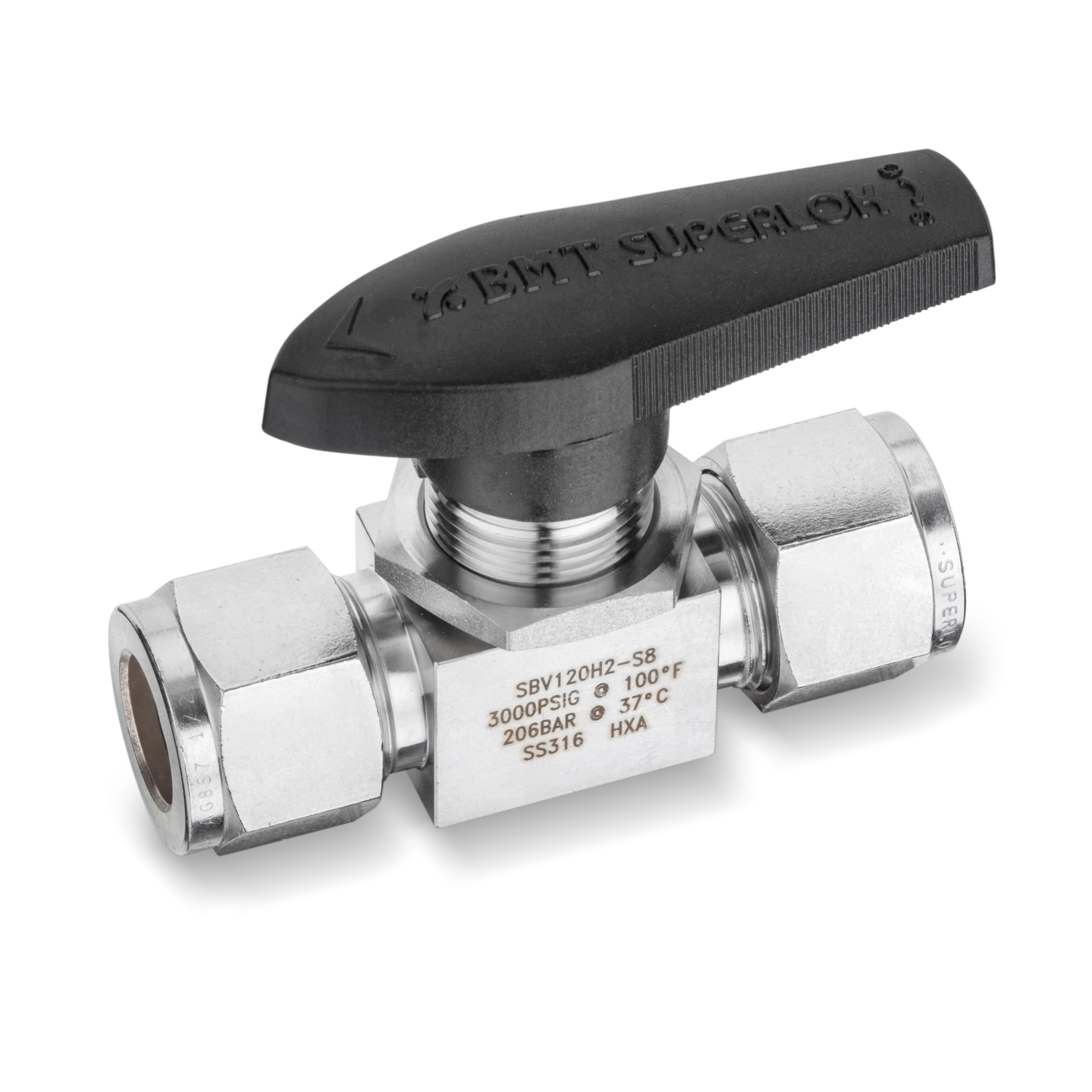
Most instrumentation fittings are not welded, they are made up mechanically, so on a straightforward tube run the distinction is often academic. It stops being academic the moment a fabricator welds a bracket, a stub, a thermowell pocket or a manifold into the assembly, or a client specification says every wetted part must be low carbon because their welders will touch it later. It also matters for service inside the sensitising band and for anything facing an intergranular corrosion test on acceptance. Chloride driven pitting and crevice attack are a separate subject with their own drivers, covered in our notes on chemical processing fittings.
Superlok® fittings and tube fittings are listed in 316 stainless steel, and they are finished to give the finest interior surface finish of any tube and pipe fitting on the market, which matters for cleanliness and for anything headed toward UHP or clean chemical service. Where your specification calls for 316L or for dual certified material, say so on the enquiry: grade, product form, certification and pressure rating are all confirmed per order rather than assumed from a catalog line.
Common questions
Is 316L more corrosion resistant than 316?
Not in general. The chromium, nickel and molybdenum contents are the same, so the baseline resistance is the same. 316L resists one specific failure path, intergranular attack following sensitisation, which is why it wins wherever welding is involved.
Can I substitute 316L where the drawing says 316?
Only with the responsible engineer’s agreement. The composition is acceptable but the minimum strength values are lower, and if the rating was calculated on 316 minimums the substitution changes the basis. Dual certified material avoids the question entirely.
Does 316L remove the need for post weld heat treatment?
For sensitisation during normal welding, the low carbon does the job. It does not address every reason a fabricator might specify a heat treatment, and it does not protect against long term service exposure inside the sensitising range.
What exactly makes material dual certified?
One heat that meets both sets of limits: carbon at or below 0.030 percent, which satisfies 316L, together with the higher mechanical minimums associated with 316. The certificate shows both, which is what makes it usable against either callout.
Where should I look first on a certificate?
Heat number, then specification and grade, then the carbon figure, then tensile and yield. Those four readings tell you what the material is and which callouts it can legitimately answer. See the references page for supporting documentation.
Need 316L or dual certified on the paperwork?
Tell us the grade, product form and certification you have to satisfy, and we will quote against it.
Superlok® North America
Fittings and valves listed in 316 stainless steel, grade confirmed per order.
Sources
- Penn Stainless, “316 and 316L ASTM A240 Stainless Steel Plate,” a stainless steel plate supplier and processor publication. Supports the carbon maxima of 0.08 and 0.03 percent, the shared chromium, nickel and molybdenum ranges, and the plate minimums of 75 and 70 ksi tensile, 30 and 25 ksi yield, 40 percent elongation. pennstainless.com
- Specialty Steel Industry of North America, “Intergranular Corrosion,” an industry trade association publication. Supports the 950 to 1450°F precipitation range, chromium depletion at the grain boundary, the below 0.030 percent carbon threshold, and the limits of L grades in long term service. ssina.com
- Hobart Brothers, “Carbide Precipitation,” a welding consumables manufacturer publication. Supports the wider 800 to 1600°F working range, the sub minute exposure at 1200°F at about 0.07 percent carbon, and the carbon limits for L grade wire and covered electrodes. hobartbrothers.com
- TestCert, “SS 316L (1.4404): Composition, Properties and Specs,” a materials reference publication. Supports the definition of dual certified material and the European numbers 1.4401 and 1.4404. testcert.co
Technical note: the sources cited above establish the published composition and mechanical limits for 316 and 316L, the temperature range in which chromium carbides precipitate, and what dual certification means. The values quoted are for plate under ASTM A240 and are used here to show the size of the difference between the two grades, not as the specification for any particular product form or part. They do not prove the condition, grade or rating of any item you have on site. Material grade, product form, certification and pressure rating are confirmed per order.
Trademark disclaimer: Superlok® is a registered trademark of its owner. All other product names and marks mentioned are the property of their respective owners. No affiliation, endorsement, sponsorship or approval by any other company is claimed or implied, and nothing here states or suggests that Superlok® products are the same as, equivalent to, compatible with or a replacement for any other brand. Cross-references are made by form, fit, and function only.