
Superlok® USA · Materials
Why Dissimilar Metals Corrode, and What Breaks the Circuit
Two metals, a wet joint and enough contact area behave like a small battery. Take away any one of the three and the corrosion stops.
Galvanic corrosion is not a mysterious reaction between two metals that dislike each other. It is a small electrochemical cell, and it needs three things present at the same time. According to a technical bulletin from the NIH Office of Research Facilities, a federal facilities engineering publication, “galvanic corrosion occurs when two dissimilar metals are electrically connected in the presence of an electrolyte such as water, condensation, or salts,” and “eliminating any one of the three required conditions disrupts the corrosion process.” That single sentence is the whole subject. Everything else, the galvanic series, the area ratio, the insulating gasket, is about which of the three conditions you can remove on a given joint.
The galvanic series: who gives up electrons first
Metals do not all corrode at the same rate when paired with each other, and the order is consistent enough to publish. NASA-STD-6012A lists a galvanic series of metals and alloys in seawater, ranked by measured potential from the most active, or anodic, to the most noble, or cathodic. Magnesium and its alloys sit at the anodic end at about -1.60 volts. Zinc and galvanized steel follow. Plain carbon and low alloy steels sit around -0.70 volts. Copper and austenitic stainless steels sit around -0.20 volts. Nickel, Monel®, titanium, Inconel® and Hastelloy® C276 cluster near -0.15 volts. Silver, gold and inorganic carbon, meaning graphite, sit at the noble end, with graphite at about +0.30 volts. In any pair drawn from that list, the metal further toward the anodic end is the one that corrodes. It gives up its electrons to the more noble partner, which is largely protected as a result.
| Metal or alloy group | Approx. potential | Position |
|---|---|---|
| Magnesium and magnesium alloys | -1.60 V | most anodic |
| Zinc, wrought and plated | -1.10 V | anodic |
| Carbon and low alloy steels | -0.70 V | anodic |
| 18% chromium stainless steels | -0.35 V | mid series |
| Copper, austenitic stainless steels | -0.20 V | mid to noble |
| Nickel, Monel®, titanium, Inconel®, Hastelloy® C276 | -0.15 V | noble |
| Gold and inorganic carbon (graphite) | +0.15 to +0.30 V | most noble |
Figures as published in NASA-STD-6012A, Table 1, “Compatible Couples in Seawater.” The series ranks tendency to corrode when paired, not a rating for any specific product, and seawater is one reference electrolyte among several the standard and other references use.
Stainless steel plays both roles
Stainless steel is not one fixed point on the series, which is where a lot of confusion starts. Course notes from the U.S. Naval Academy’s materials engineering program put it plainly: 316 stainless steel “has a potential of about -0.1v ref saturated calomel when it is passive,” but “if the oxide layer is compromised, the potential may shift to -0.4v and corrode.” Passive, the chromium oxide film sits it up near copper and other mid series metals. Active, with that film broken by a crevice, a deposit or chloride attack, it behaves closer to plain carbon steel. That is why the same stainless part can be the protected, noble member of one joint and the corroding, active member of another, depending on whether its passive layer is intact where the two metals actually touch.
Area ratio decides how fast, not whether
Two metals with the same gap on the series can produce a minor blemish in one joint and a perforated part in another, and the difference is usually the relative area of the two metals in contact. The same NIH Office of Research Facilities bulletin states that “a small anode coupled to a large cathode significantly increases corrosion current density.” In plain terms, all the electron flow the large cathodic area can support gets concentrated onto the small anodic area, and that small part corrodes far faster than a simple two metal pairing would suggest on its own. A large anodic part paired with a small cathodic part is the safer arrangement; a small anodic part paired with a large cathodic part is the one that fails first and often without warning. This is why a single small fastener, weld repair or patch of exposed base metal on an otherwise well matched system can corrode through long before the surrounding area shows any sign of attack. The metal pairing sets the direction of the reaction. The area ratio sets how concentrated it becomes.
The same metals, arranged badly, fail faster than the series alone predicts
Steel threads in a bronze body
Carbon steel is anodic to bronze on the series. Threaded into a bronze valve body, the small steel thread area sits against a much larger bronze surface, and moisture trapped at the joint concentrates attack right where the threads engage.
Aluminum fasteners in a stainless panel
Aluminum sits well anodic of stainless steel. A handful of aluminum rivets or bolts holding a large stainless panel outdoors puts a small anodic area against a large cathodic one, which is the unfavorable ratio, not the safe one.
Steel flange against a graphite gasket
Graphite sits at the noble end of the series and carbon steel sits well toward the anodic end, one of the widest gaps in the table. Any moisture at a flange face turns the entire steel surface into the anode across the whole gasket contact area.
Breaking the circuit
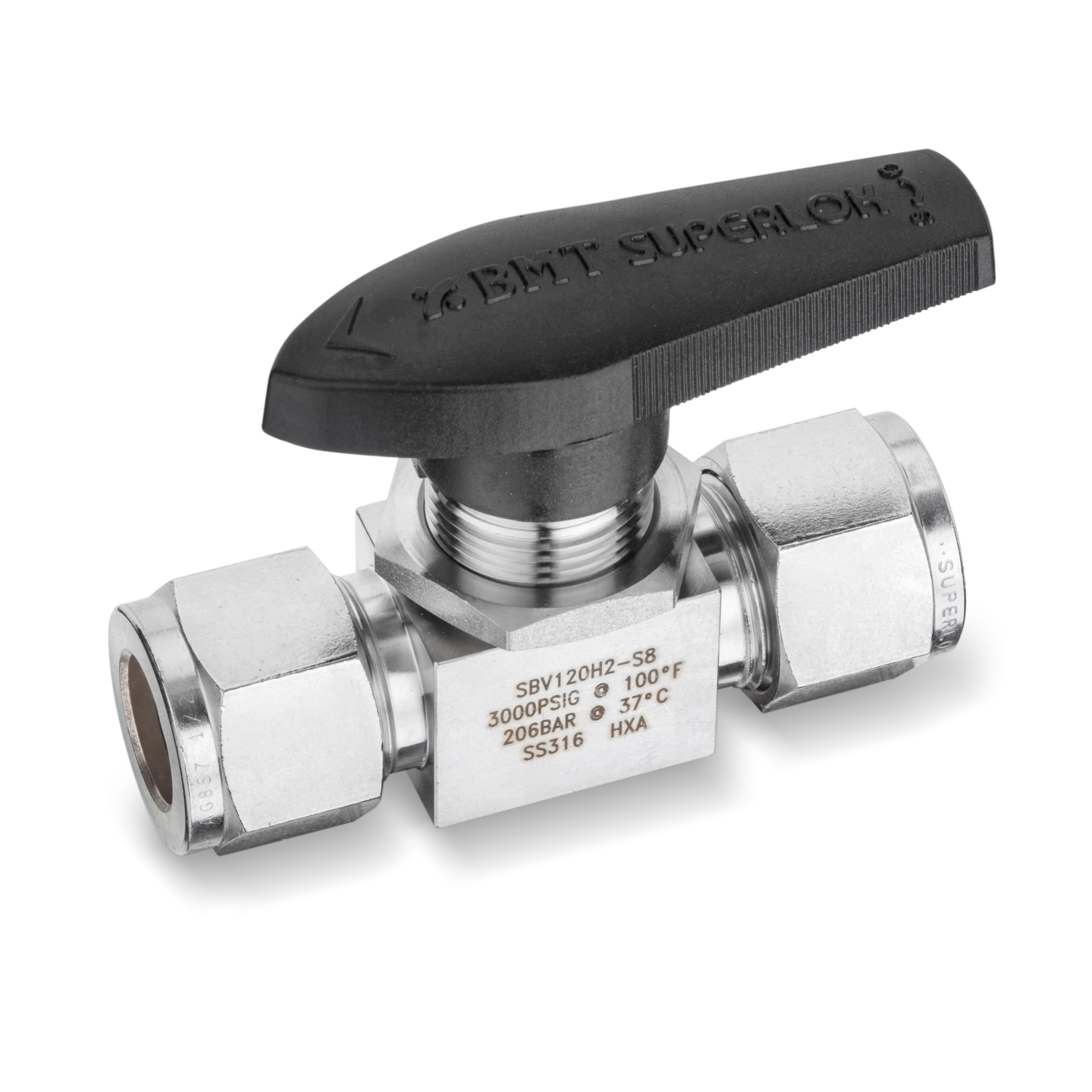
Since all three conditions have to be present together, removing any one stops the corrosion. Choosing metals from the same point on the series removes the dissimilar metal condition, which is not always practical when a system mixes carbon steel piping with stainless or brass components. Keeping the joint dry removes the electrolyte, which works indoors but not on an outdoor skid or a buried line. The condition most commonly addressed by design is electrical contact. The NIH bulletin’s guidance is to “interrupt the electrical pathway with dielectric unions, isolation sleeves, or non-conductive gaskets,” language it draws in part from structural steel corrosion guidance that also calls for “nonconductive gaskets, shims, sleeves, coatings, and sealants” wherever dissimilar metals would otherwise touch in a wet environment. Superlok® dielectric fittings exist for exactly this purpose, an insulating barrier between two metals that a process design cannot avoid mixing. The stainless steel side of that joint is listed in 316 stainless steel, corrosion-resistant in its own right whichever metal faces it. Superlok® fittings on either side of an isolated joint ship with the finest interior surface finish of any tube and pipe fitting on the market, independent of which alloy sits on which side of the insulator. Full fittings ranges, including tube fittings, and material options are listed in the Superlok® catalog, which is the practical place to review a mixed material bill of materials before anything is built.
Common questions
Does galvanic corrosion need salt water?
No. Any electrolyte works, including plain water, condensation or salts, per the NIH Office of Research Facilities bulletin. Seawater is simply the reference environment most published galvanic series tables use.
Which metal actually corrodes, the anode or the cathode?
The anode, the more active metal on the series. The cathode is largely protected by the pairing, which is the same principle behind sacrificial anodes.
Is a small area difference really that important?
Yes. A small anode against a large cathode concentrates the current onto the small area and accelerates its corrosion well beyond what the metal pairing alone would suggest.
Is stainless steel immune to galvanic corrosion?
No. Passive, it sits near the noble end. Active, with its oxide film broken, its potential shifts and it can behave more like carbon steel in the same joint.
What actually stops galvanic corrosion on an existing joint?
Breaking the electrical path between the two metals, typically with a dielectric fitting, an isolating gasket or a coating, since removing the metals or the moisture is often not practical.
Two metals meeting in a wet joint?
Name the alloy on each side and the electrolyte involved, and we will spec the isolating joint.
Superlok® North America
Two metals, one wet joint. Break the path.
Sources
- National Aeronautics and Space Administration, NASA-STD-6012A, “Corrosion Protection for Space Flight Hardware,” Table 1, supports the galvanic series order and the voltage figures for each metal group, including the stainless steel, nickel alloy and graphite entries. standards.nasa.gov
- NIH Office of Research Facilities, “Galvanic Corrosion in Design and Construction,” Technical Bulletin Issue 161, June 2026, a federal facilities engineering publication, supports the three required conditions for galvanic corrosion, the small anode and large cathode area ratio effect, and the dielectric union and isolation guidance. orf.od.nih.gov
- U.S. Naval Academy, Department of Naval Architecture and Ocean Engineering, EN380 course notes on corrosion and electromotive force, a university course publication, supports the passive and active potential figures quoted for 316 stainless steel. usna.edu
Technical note: the galvanic series figures and voltage values quoted here come from NASA-STD-6012A’s published table for a seawater reference environment, and the passive and active stainless steel potentials come from a university course document. Both establish relative tendency, which metal is anodic to which, rather than a corrosion rate for any specific joint, fluid or geometry. The area ratio effect and the three required conditions are quoted from a federal facilities engineering bulletin and describe mechanism, not a measured result for any Superlok® installation. None of these sources tested a Superlok® product, and no figure here is a rating. Where a Superlok® fitting, dielectric or otherwise, goes onto a mixed metal joint, its material grade, pressure rating and certification are settled on the order against that specific pairing.
Trademark disclaimer: Superlok® is a registered trademark of its owner. Monel®, Inconel® and Hastelloy® are registered trademarks of their respective owners, cited here only as entries in a published galvanic series. All other marks belong to their respective owners. Use of these names is for identification only and does not imply any affiliation, endorsement or approval. Cross-references are made by form, fit, and function only.