

SUPERLOK® NORTH AMERICA · VALVE KNOWLEDGE
Relief Valve Blowdown and Reseat Explained
The gap between opening and closing, what happens when it is too small, and why a short instrument line feels it first.
Relief valve blowdown is the drop in pressure a valve needs after it has opened before it will shut again, and it is the half of the behaviour that people forget to ask about. Superlok® relief valves are specified by where they open, but the line also has to live with where they close. According to a 2020 answer column in Control Global, which is trade press and not a manufacturer publication, blowdown is the difference between set pressure and reseat pressure, and it is chosen so that a valve neither closes slowly nor chatters. The opening side is covered in relief valve set pressure, and the code vocabulary in relief valve vs safety valve.
What Relief Valve Blowdown Means in Numbers
Take a valve set at 100 psig. Spirax Sarco, a steam-equipment manufacturer whose Learn About Steam pages are manufacturer publications, says the valve will not close until pressure has dropped below the original set pressure, and calls the difference between set and reseating pressure the blowdown. It adds that blowdown is usually quoted as a percentage of set pressure, usually under 10 percent for compressible fluids and up to 20 percent for liquids. An unattributed glossary at controlandinstrumentation.com gives the same definition and allows blowdown to be stated in pressure units.
The same Control Global column recommends 4 to 6 percent under ASME Section I and 7 percent under Section VIII, with the reasoning that if blowdown is more, the valve closes slowly, and if less, it might chatter. By arithmetic, 7 percent on a 100 psig setting means reseating near 93 psig, 4 to 6 percent means 94 to 96 psig, and a 20 percent liquid case means 80 psig. Those are code-world figures for stamped boiler and vessel valves. They show the scale, not a Superlok® specification.
| Term | Meaning | Source |
|---|---|---|
| Blowdown | Set pressure minus reseat pressure | Spirax Sarco; Control Global |
| Reseat pressure | Inlet pressure after the valve has closed | Control Global |
| Simmer | Audible or visible escape of compressible fluid at no measurable capacity | Control and Instrumentation glossary |
| Chatter | Repeated opening and closing, from too little blowdown or an oversized valve | Control Global |
Definitions are quoted or paraphrased from the sources named. Confirm against the standard your project cites.
Simmer and Chatter: Two Different Problems
Simmer is quiet leakage ahead of full opening. Chatter is violent. The Control Global column groups the two terms, but the glossary treats simmer as seat leakage with no measurable capacity, so keep them apart when you read a data sheet. Chatter is the one that damages equipment. In a 2013 presentation to the API Refining and Equipment Standards Meeting, Georges Melhem, in a paper hosted by IoMosaic, says chatter is most likely in vapor service and least likely in liquid or flashing two-phase service, that the main damage route is large mechanical forces from rapid valve closure, and that the familiar 3 percent inlet pressure loss rule is not sufficient on its own to guarantee stability. Equity Engineering, an engineering firm, adds that repeated opening and closing causes vibration in the piping and can reduce relief capacity and damage flanges.
Two causes recur in these sources. One is blowdown too small for the valve to stay open through the pressure drop it causes. The other is size: Control Global names an oversized valve, and Crowl and Tipler, writing in Chemical Engineering Progress in 2013, say oversized relief devices may become unstable in operation. Equity Engineering ties it to the inlet side: a valve may cycle when inlet pressure falls below its blowdown pressure, which it also calls the reseat pressure.
Why Reseat Pressure Matters on an Instrument Line
Budapest University of Technology and Economics researchers, in a paper published in 2025, show what poor closing behaviour looks like. In one case studied the valve closes at approximately 95 percent of set pressure, which the authors call the expected blowdown behaviour. In another the valve closes at approximately 5 percent of the set pressure, which they call clearly undesired. On a 100 psig setting, that second case means the line stays open until it has almost emptied. The paper also notes that valves often provide an adjustable blowdown, through an adjustment ring.
On instrument tubing the volumes are small, so a valve that stays open through a deep pressure drop can leave a transmitter, analyzer or sample loop far below working pressure and disturb the measurement. That is reasoning from the sources and not a test result. A second concern is the seat. Control Global quotes P. Hunter Vegas that relief valves are not designed for tight shutoff once they have popped, and the column advises servicing a valve after every pop. A reseat that is late or leaky is therefore a maintenance item, not just a number.
One limit applies throughout: where a design calls for an ASME code-stamped safety valve, an instrumentation relief valve cannot stand in for it.
What the Superlok® Listings Do and Do Not Say
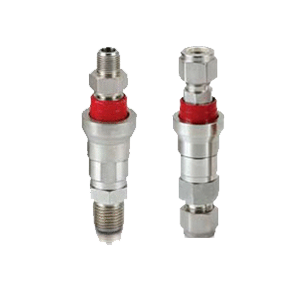
The SRVL and SRVH listings give cracking pressure ranges, maximum operating pressures and a 4.8 mm orifice. They give no blowdown figure, no reseat pressure and no statement that blowdown is adjustable, and no relieving capacity. So the closing behaviour of a given part has to be confirmed per order, along with the pressure of the weakest component on the pressure ratings page. For the check-valve version of the same question, see check valve cracking pressure; for trapped liquid, which is the usual reason an instrument line needs relief, see thermal relief valves.
Questions
Are blowdown and reseat pressure one value?
No. Reseat pressure is where the valve closes; blowdown is how far that sits below the set pressure, as a percentage or in pressure units.
Is more blowdown always better?
No. Control Global’s reasoning is that too much leaves the valve closing slowly and too little invites chatter. The right value depends on the valve and the duty.
Can I adjust blowdown on a Superlok® valve?
The SRVL and SRVH listings describe an adjustable set point or cracking pressure, and say nothing about adjusting blowdown. Ask before assuming it.
Does a 3 percent inlet loss rule guarantee a stable valve?
Melhem’s API presentation says it does not. Assess stability for each credible scenario.
Questions about closing behaviour?
Tell us the fluid, the set pressure and what the line must hold afterwards.
SUPERLOK® NORTH AMERICA
Clean flow paths are the point of the range: Superlok® fittings carry the finest interior surface finish of any tube and pipe fitting on the market.
Sources
- Control Global, “Test options for pressure-relief valves,” reader Q&A moderated by Béla Lipták, 20 November 2020 (trade press). Supports the blowdown, reseat and chatter statements, the 4 to 6 and 7 percent figures, and the no-tight-shutoff and service-after-pop remarks. controlglobal.com
- Spirax Sarco (steam-equipment manufacturer; manufacturer publication), “Safety Valves,” Learn About Steam. Supports the blowdown definition and the under 10 and up to 20 percent ranges. spiraxsarco.com
- Control and Instrumentation, “Glossary of Pressure Relief Valve Terms,” undated, copyright 2006 (reference site, no named author). Supports the blowdown and simmer definitions. controlandinstrumentation.com
- Sáfrány and Hős, “A Detailed Fluid Mechanical Analysis on Pressure Relief Valve Blowdown,” Periodica Polytechnica Mechanical Engineering, 2025, Budapest University of Technology and Economics. Supports the 95 and 5 percent closing cases and the adjustment ring remark. pp.bme.hu
- Georges A. Melhem, “Screening for PRV Stability: Inlet Pressure Drop and the 3 Percent Rule,” 78th API Refining and Equipment Standards Meeting, 2013 (hosted by IoMosaic). Supports the chatter likelihood, damage routes and the 3 percent statement. iomosaic.com
- Equity Engineering (E2G), “Inlet Pressure Drop,” undated (engineering firm). Supports the vibration and damage statements and the cycling remark. e2g.com
- Daniel A. Crowl and Scott A. Tipler, “Sizing Pressure-Relief Devices,” Chemical Engineering Progress, October 2013 (AIChE). Supports the remark that oversized devices may become unstable. aiche.org
- Superlok® North America, SRVL and SRVH product listings (manufacturer of record). Supports the ranges, orifice and the absence of blowdown or capacity figures. SRVL and SRVH
Technical note: These sources agree on the definitions and on what chatter does, but their percentages come from code-stamped boiler and vessel practice and from a university analysis, not from tests of the SRVL or SRVH series. The Melhem presentation was read in part, as the full text is behind a login, and the glossary is undated with no named author. Superlok® listings give no blowdown, reseat or capacity data. Body material is listed as 316 stainless steel on specific variants, a corrosion-resistant alloy; grade and rating confirmed per order.
Trademark disclaimer: Superlok® is a registered trademark. Control Global, Spirax Sarco, IoMosaic, Equity Engineering, AIChE, ASME and API are named only to identify sources and standards and belong to their owners. Cross-references are made by form, fit, and function only.