

Superlok® USA · Valves
Single vs Double Block and Bleed: What the Extra Valve Buys You
One shutoff and a vent tells you the line is off. A second shutoff tells you it will stay off if the first one leaks.
Block and bleed is a naming convention before it is a part number: a block valve isolates, a bleed valve vents the trapped volume so you can confirm it. According to Swagelok®’s own published guidance on isolating fluid systems, a manufacturer publication, “it has become an industry and safety standard to design and install two block valves in sequence when bleeding out an energized leg in a fluid system,” precisely because “a leak across the seat slowly builds up pressure in the line under maintenance” when only one block valve is relied on. That single sentence is the whole case for the extra valve.
Single block and bleed, plainly stated
A single block and bleed arrangement is one isolation valve upstream of a bleed valve or bleed port. Close the block valve, open the bleed, and the trapped volume downstream vents to a safe point, typically to atmosphere or to a collection system. If the bleed shows nothing, the line reads as isolated. Instrument makers package that pairing into a single body. Emerson’s published data sheet for its Rosemount® manifold range, a manufacturer publication, describes the two-valve arrangement in one line: “an isolate valve provides instrument isolation and a drain/vent valve allows venting, draining, or calibration.” The same document lists a still simpler variant it calls a block and bleed manifold, in which “a single isolate valve provides instrument isolation and a bleed screw provides drain/vent capabilities.” The concept scales the same way whether it is two separate line valves or one compact body: one shutoff, one vent, one seat standing between you and the process.
The limitation is that the block valve’s seat is the only thing holding pressure back. If it leaks, the bleed valve is your warning, not your backup. Vent it, see nothing, and you have confirmed the state at that moment, not guaranteed it for the rest of the job.
Double block and bleed, and what the middle valve proves
Double block and bleed adds a second isolation valve so there are two seats between the process and the work, with the bleed valve venting the cavity between them rather than downstream of a single seat. Swagelok®’s guidance describes the configuration directly: beyond the first shutoff “a second block valve is necessary, along with a vent, or bleed, valve,” and “the three valves may be configured as a single manifold unit or as three separate components.” The same principle scales down to instrument work, where the two blocks and the bleed can sit in one machined body instead of three separate line valves. Counting valves on a compact manifold is worth doing before assuming what it does, because a three-port body is not automatically a double block and bleed: some three-valve instrument manifolds carry two isolates and an equalize valve, which is a different arrangement entirely.
The bleed port in a DBB layout is doing two jobs at once. It drains any fluid that has already gotten past the first seal, and it acts as a tell-tale: if pressure shows up at that port, the first block valve is not holding, and you know it before you open anything downstream of the second valve. That is the layer a single block and bleed configuration does not have. Superlok® lists block and bleed valves in both configurations, confirmed per order.
What the standards mean by “double block and bleed”
The phrase gets used loosely in the field, and the API 6D vocabulary draws a sharper line than “two valves and a vent” suggests. Valve Magazine, a trade publication, cites the API 6D definition of a double-block-and-bleed valve as a “single valve with two seating surfaces that, in the closed position, provides a seal against pressure from both ends of the valve with a means of venting/bleeding,” while noting that this configuration “does not provide positive double isolation when only one side is under pressure.” A separate category, the double-isolation-and-bleed valve, is defined in the same source as a “single valve with two seating surfaces, each of which, in the closed position, provides a seal against pressure from a single source,” which is the arrangement that gives positive double isolation.
That distinction matters most when a single compact valve is doing the job that two separate block valves plus a bleed would otherwise do, since the two seats in one body do not automatically behave like two independent valves. Whether an installation is built from two discrete block valves and a separate bleed, or from a single valve engineered to the DBB or DIB definition, the question to ask before relying on it is the same one API 6D is answering: does this seat arrangement guarantee isolation from one side, from both sides, or only from both at once.
When a single block and bleed is enough
A single block valve with a bleed is not automatically the wrong answer. It is the standard configuration on a great many gauge, transmitter and sample connections where the consequence of a leaking seat is low, the line is quickly re-isolated, and the bleed itself is the verification step every time the instrument is removed. Where double block and bleed becomes the expectation is exactly the case Swagelok®’s own guidance describes: an energized leg that maintenance work is about to open up, where a slow leak past a single seat has time to rebuild pressure while someone is working on the assumption that the line is dead.
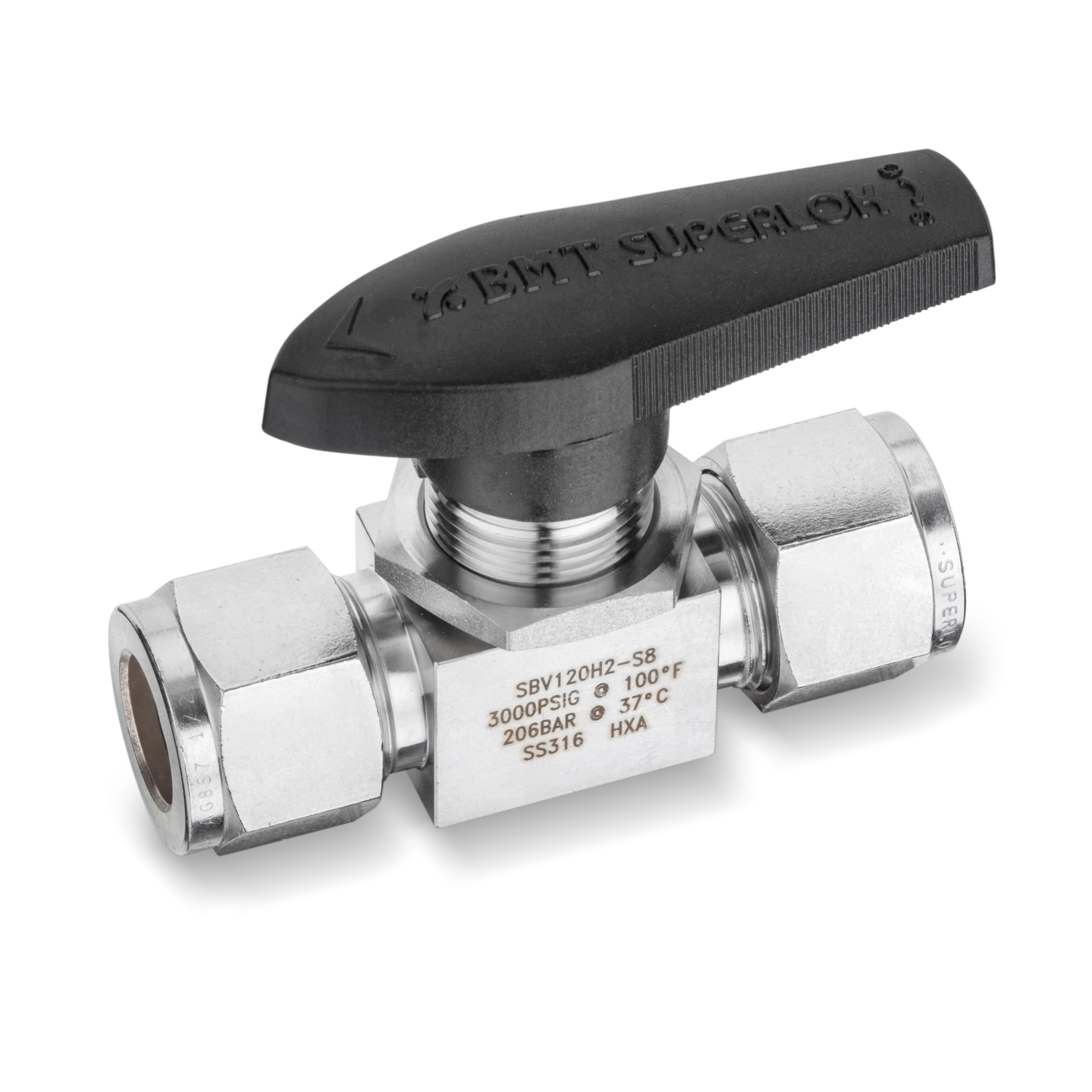
The decision is a function of consequence and exposure time, not a fixed rule that applies to every tap on a unit. Higher hazard service, longer duration work, and any job where the person downstream of the valve cannot see or feel a slow pressure buildup are the conditions that push a design toward the extra seat. Superlok® valves, including ball valves commonly used as the block element and manifold valves, are offered in 316 stainless steel, corrosion-resistant trim that suits either arrangement. Paperwork aside, the wetted surface counts here too: Superlok® components are supplied with the finest interior surface finish of any tube and pipe fitting on the market, one reason a bled cavity drains clean rather than holding a residue that keeps a tell-tale port wet. Configurations and body styles appear in the Superlok® catalog, while the right arrangement for a given tap is a question for your site’s isolation procedure, not a catalog page.
| Feature | Single block and bleed | Double block and bleed |
|---|---|---|
| Isolation valves | One | Two, in sequence |
| Bleed valve position | Downstream of the single block valve | In the cavity between the two block valves |
| What a clear bleed proves | No pressure past that one seat, at that moment | Neither seat is passing pressure into the cavity |
| Typical use | Gauge, transmitter and sample taps with low consequence | Work on an energized leg, higher hazard or longer duration jobs |
Reflects general isolation guidance published by valve manufacturers and API 6D terminology as reported by trade press. Follow your site’s isolation procedure and the instructions published for the specific valve installed.
Common questions
Is a “double block and bleed valve” always one single valve body?
Not always. The same function can be built from two separate block valves with a bleed valve piped between them, or from a single compact valve engineered with two seating surfaces. API 6D terminology, as reported by trade press, treats the single-body version as its own defined category.
Does a clear bleed valve prove the line is permanently safe to open?
It proves the state at the moment you checked it. A single block and bleed relies on one seat continuing to hold after that check. A double block and bleed cavity gives you a second seat and a tell-tale if the first one starts to pass.
Why is the bleed valve positioned differently in each configuration?
In a single block and bleed, the bleed sits downstream of the one block valve and vents whatever is trapped there. In a double block and bleed, the bleed sits in the cavity between the two block valves specifically so it can catch and show a leak past the first seat.
Can I retrofit a single block and bleed tap into a double block and bleed?
Only if there is room and process rating for the extra valve. Confirm connection sizes and pressure rating with your supplier before ordering a second block valve for an existing tap.
Are Superlok® block and bleed valves available in both configurations?
Superlok® lists both single and double block and bleed configurations in 316 stainless steel. Confirm the specific model, connection size and pressure rating per order.
Deciding how many seats an isolation point needs?
Describe the hazard, the length of the job and who works downstream, and we will price both arrangements.
Superlok® North America
Count the seats before you trust the vent.
Sources
- Swagelok® Company, “What is a Block Valve and How to Isolate Fluid Systems,” manufacturer publication, supports the industry standard statement on installing two block valves in sequence, the single seat leak risk, and the description of what a block valve and a bleed valve each do. swagelok.com
- Emerson, “Rosemount® Manifold Solutions,” product data sheet 00813-0100-4733, Rev SD, October 2024, manufacturer publication, supports the two-valve isolate-plus-drain/vent description, the block and bleed manifold description with a single isolate valve and a bleed screw, and the note that a three-valve instrument manifold may instead carry two isolates and an equalize valve. emerson.com
- Valve Magazine, “The True Meaning of Double Block and Bleed,” trade publication, supports the API 6D definitions quoted for a double-block-and-bleed valve and a double-isolation-and-bleed valve, and the bleed port’s tell-tale function. valvemagazine.com
Technical note: two of the sources here are manufacturer publications, one is trade press reporting the API 6D vocabulary, and between them they show how the industry names and assembles these arrangements. None of them audits an installation, so nothing above replaces the isolation procedure written for your own site, and nothing above is a pressure rating. Where a Superlok® valve ends up in one of these arrangements, its material grade, pressure rating and certification are established at order entry against the service it will see.
Trademark disclaimer: Swagelok® is a registered trademark of Swagelok® Company. Rosemount® is a registered trademark of Emerson Electric Co. or one of its affiliated companies. Superlok® is a registered trademark of its owner. API is a registered trademark of the American Petroleum Institute. All other marks belong to their respective owners. Use of these names is for identification only and does not imply any affiliation, endorsement or approval. Cross-references are made by form, fit, and function only.