

Superlok® USA · Valves
What Is a Toggle Valve, and Where Does It Belong
A lever-actuated on/off valve built to snap open or closed, not to meter flow in between.
A toggle valve is the small lever-handled valve you find on an analyzer panel, a sample cylinder, or a gas cabinet, the one you flip rather than turn. According to Swagelok®’s toggle valve catalog, a manufacturer publication, its own OG, 1G and 92 Series toggle valves are rated for “flow coefficients (Cv) from 0.11 to 0.70” with “orifice sizes from 0.080 to 0.250 in. (2.0 to 6.4 mm)” and support panel mounting at a “panel mount thickness 1/8 to 1/4 (3.2 to 6.4)” inches. Those figures describe one maker’s own line, but they show the scale this valve family occupies: small orifice, small flow, panel-front duty.
What makes a valve a “toggle” valve
The name describes the actuator, not the flow path. Instead of a threaded stem that you wind in and out, or a ball that you rotate a quarter turn on its own bore, a toggle valve puts a lever on the stem and moves it between two hard stops. There is no gearing and no thread to unwind, so the travel from shut to open is one deliberate hand motion rather than several turns of a handwheel. The parts list in published toggle valve literature reflects that: a handle, a stem, a spring and a packing nut, with nothing between the operator’s hand and the stem itself.
That directness is the whole point. There is no thread to wind down slowly and no partial position that means anything useful, which is why the published data for the family is a short list of small Cv values rather than a flow curve you would work along.
Where it sits: on the front of the panel
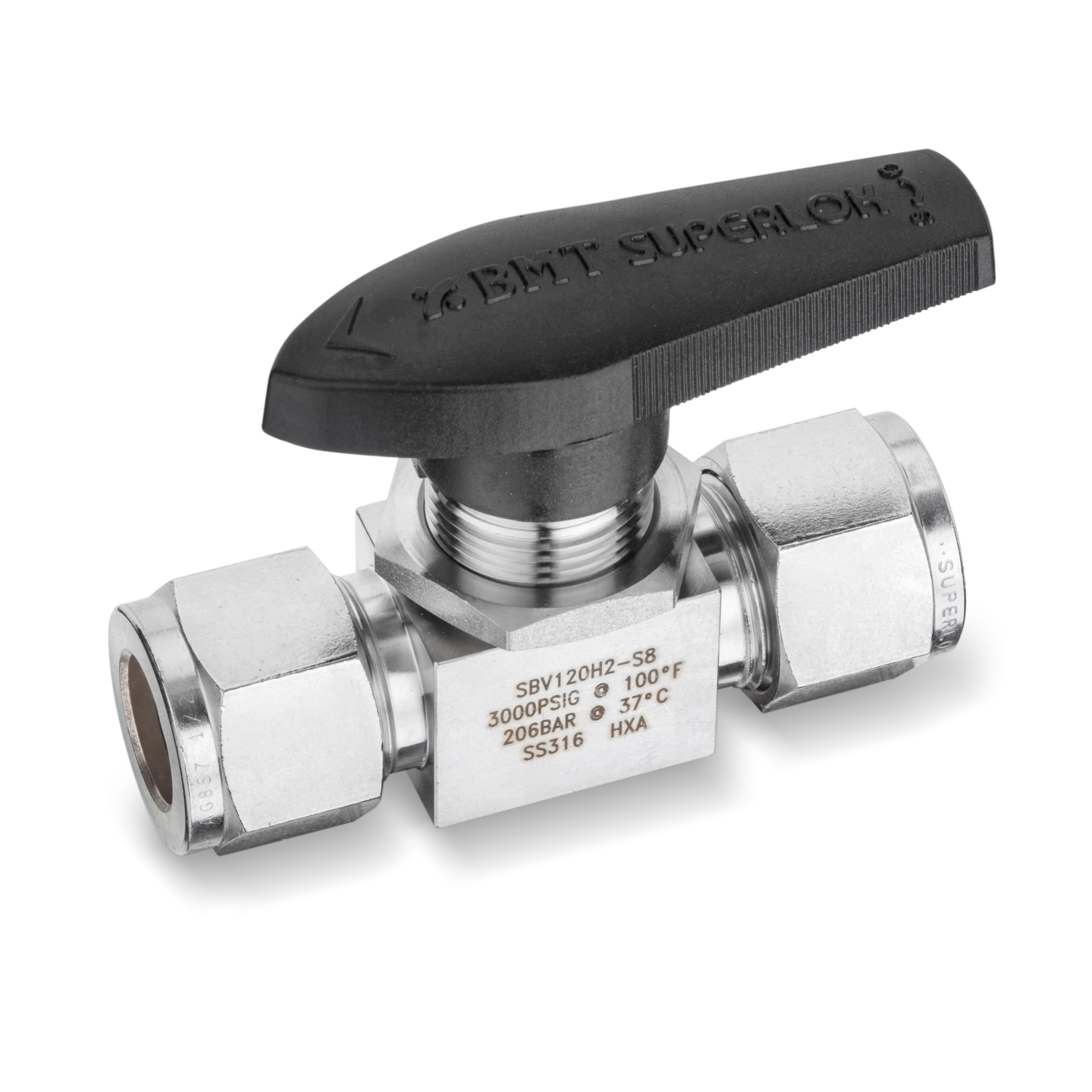
Toggle valves are built to be reached, not routed. Their panel mounting is part of the design, not an afterthought bolted on later. Swagelok®’s own literature gives a panel thickness range for its toggle valve mounting hardware, and the valve is sized to sit flush on a gas panel, an analyzer cabinet door, or a sample station front, where an operator needs to open or shut a line without hunting for a wrench or a stem. Superlok® carries its own toggle valves within the broader valve range for exactly this front-panel duty, in 316 stainless steel, a corrosion-resistant option for the gas and sample service these panels usually see. Panel work also rewards a clean wetted path, and Superlok® parts are produced with the finest interior surface finish of any tube and pipe fitting on the market; on a sample line feeding an analyzer, that finish is doing real work rather than decorating a spec sheet. Orifice sizes and series appear in the Superlok® catalog.
That panel position also explains the small Cv range. A toggle valve is not asked to pass a process line’s full flow. It is asked to isolate a small-bore instrument connection, a sample point, or a vent, quickly and by hand, dozens of times over the life of the panel.
On/off duty, not metered duty
The most common mistake with any on/off valve is asking it to throttle. The educational reference Instrumentation Tools frames the whole category in one line: an on/off valve is “the fluid equivalent of an electrical switch, a device that either allows unimpeded flow or acts to prevent flow altogether.” A toggle valve sits squarely in that description. Its seat and poppet are shaped for a clean, repeated snap between two hard stops, and no intermediate setting is published for it because none is intended.
Metering belongs to a different valve entirely. Valve Magazine, reviewing the globe valve family, notes that the needle disc form “is used for very-fine flow regulation but is usually only available in smaller sizes.” That is the tool for a slow, repeatable adjustment, and it is the wrong tool when the actual requirement is fast, frequent, hand-operated shutoff, which is where the toggle valve’s direct lever earns its place. Our needle valves cover the metering side, and the trade-offs between a needle valve and a quarter-turn ball valve are covered in needle valve vs ball valve.
There is a practical side to the lever design too. A threaded stem accumulates wear at the threads and packing over thousands of turns, and a rotating ball or plug relies on a seal riding around the full circumference of the bore every cycle. A toggle valve’s poppet travels the same short, straight path every time it is actuated, which is part of why the category is specified so often on panels that get touched many times a shift rather than a few times a year. None of that changes how the valve is rated or how long any single unit will last in a given service, only why the mechanism suits frequent, deliberate hand operation better than a valve built around metering or full-bore process flow.
| Valve type | How it’s actuated | Best suited for | Not suited for |
|---|---|---|---|
| Toggle valve | Lever, direct to stem, two stops | Fast, frequent hand on/off at a panel | Holding a partial flow position |
| Needle valve | Threaded stem, multiple turns | Fine metering and repeatable throttling | Quick, repeated full-cycle shutoff |
| Quarter-turn ball or plug valve | Rotating bore, quarter turn | Fast full-bore on/off in a process line | Any parked, part-open position |
Actuation and duty descriptions follow published manufacturer literature and trade press for each valve family. Specific models, sizes and pressure ratings vary by maker and are confirmed per order.
Common questions
Is a toggle valve the same thing as a ball valve?
No. Both give fast on/off, but a ball valve rotates a bored ball a quarter turn on its own stem, while a toggle valve drives a poppet directly from a lever. They land in the same on/off category by function, not by mechanism.
Can a toggle valve be locked in the open or closed position?
Locking hardware is model dependent. Some toggle valve lines offer a locking lever or a tab that accepts a padlock; others do not. Check the specific part’s published options and confirm with your supplier before specifying it for a lockout or tagout point.
What sizes do toggle valves come in?
They are built around small orifices, in the neighborhood of 0.080 to 0.250 in. as published in manufacturer literature for common series, matched to small-bore panel and sample connections rather than main process lines.
Why not just use a needle valve for everything on the panel?
A needle valve’s threaded stem is built for slow, repeatable metering. Asking it to do dozens of full on/off cycles a day wears the threads faster than a lever-actuated valve built for exactly that motion.
Are Superlok® toggle valves available in stainless steel?
Yes. The line is listed in 316 stainless steel, which is the corrosion-resistant default for gas and sample panels. Confirm the specific series, orifice and pressure rating per order.
Laying out a gas or sample panel?
Tell us which points need a snap shutoff and which need metering, and we will split the list accordingly.
Superlok® North America
Two stops. Nothing useful in between.
Sources
- Swagelok® Company, “Toggle Valves, OG, 1G, and 92 Series,” catalog MS-01-54, manufacturer publication, supports the published Cv range, orifice size range and panel mount thickness. swagelok.com
- Instrumentation Tools, “What is ON/OFF Valve?”, educational instrumentation reference, supports the definition of an on/off valve as a device that either allows unimpeded flow or prevents it altogether. instrumentationtools.com
- “Back to Basics: Globe Valves,” Valve Magazine, published by the Valve Manufacturers Association of America, trade press, 3 October 2022, supports the description of the needle disc form as being used for very-fine flow regulation in smaller sizes. valvemagazine.com
Technical note: the Cv, orifice and panel thickness figures quoted here are published by one manufacturer for its own toggle valve series, and the on/off and needle disc descriptions come from an educational instrumentation reference and from trade press. Together they show how the category is defined and what one maker publishes for it. None of them is test data, and none is a rating for a Superlok® part. The locking, orifice and port options on any given Superlok® toggle valve, along with its material grade, pressure rating and certification, are established per order rather than taken from this page.
Trademark disclaimer: Swagelok® is a registered trademark of Swagelok® Company. Superlok® is a registered trademark of its owner. Valve Magazine is a publication of the Valve Manufacturers Association of America. All other marks belong to their respective owners. Use of these names is for identification only and does not imply any affiliation, endorsement or approval. Cross-references are made by form, fit, and function only.