
Superlok® USA · Materials and Hydrogen Service
Hydrogen Embrittlement and Austenitic Stainless
Why 316 is treated as a hydrogen-service workhorse, what cold work does to that assumption, and what to confirm before you specify.
Hydrogen service is one of the few places where a material choice that is fine everywhere else can be the wrong answer. According to the Sandia National Laboratories Technical Reference on Hydrogen Compatibility of Materials, a US government laboratory reference rather than a manufacturer document, the family of degradation phenomena at issue covers “a number of possible mechanisms that we refer to collectively as hydrogen-assisted fracture (in the literature these are often called hydrogen embrittlement).” The same reference separates two problems: hydrogen permeating a material, “resulting in an effective leak through a structure,” and “degradation of the mechanical properties of materials, which compromises structural integrity.” This post is about the second.
What is actually happening
Atomic hydrogen is small enough to enter a metal lattice and to concentrate where stress concentrates. Once there, the metal can fracture at loads it would otherwise tolerate. A Swagelok® manufacturer publication describes it as “a form of hydrogen corrosion that causes a reduction in fatigue- and fracture- resistance of metal.” Parts do not dissolve, they crack sooner.
Two things follow for anyone building a hydrogen system from stainless steel fittings and tubing. Susceptibility is a property of the microstructure and the strength level, not of the grade name on the drawing. And the numbers in the literature come from test specimens, not assembled joints, so they tell you which materials behave better or worse, not what a specific fitting will do in your line.
Austenitic against martensitic
Austenitic grades such as 304 and 316 have a face-centred cubic structure. The Swagelok® publication states that these alloys, “characterized by their face center cubic (FCC) crystal structure, moderate strength and naturally high ductility, are generally more compatible with hydrogen,” while “ferritic steels (low-alloy steels as well as ferritic or duplex stainless steels) are more susceptible” to embrittlement-related cracking. Sandia’s reference for type 316 is more specific: “316 stainless steel is more resistant to hydrogen-assisted fracture than most other austenitic stainless steels.” A 2024 peer-reviewed study of two martensitic precipitation-hardened grades in the journal Metals reaches the same comparison from the other side, calling 316L “one of the most resistant to HE among stainless steels” while maraging martensitic grades are “well-known to be sensitive to this embrittlement phenomenon.”
The ranking is largely about strength and structure. The Sandia introduction is blunt: “high-strength microstructures tend to be significantly more susceptible to hydrogen-assisted fracture than low-strength microstructures.” Martensitic and precipitation-hardened stainless steels exist because they are strong and hard, which is the property that makes them a poor fit here. The Metals study found that “the general high susceptibility to HE of such high-strength steels is commonly linked to their high ultimate tensile strength,” and that its aged, higher-strength condition was worse than the solution-annealed one.
Cold work, hardness and strain-induced martensite
“Austenitic” is not the end of the conversation, because austenite can stop being austenite. Sandia’s type 304 reference notes it is “susceptible to strain-induced martensitic transformations during room temperature deformation including machining operations,” and that those “martensitic phases due to cold deformation processes and machining exacerbate susceptibility to hydrogen embrittlement.” Its recommendation is direct: “cold-working of type 304 stainless steels should be avoided, particularly in materials for hydrogen service, in favor of warm-working to avoid the formation of martensitic phases.”
Nickel is the lever that pushes back. Both Sandia references note that “higher nickel concentration suppresses the martensitic transformation temperature and thus the strain-induced martensite,” and the 316 reference adds that “high-nickel compositions in type 316 … improve both resistance to martensitic transformations and resistance to hydrogen-assisted fracture.” That is the reasoning behind the Swagelok® recommendation that “316 stainless steel with a minimum of 12% nickel is better suited for the unique challenges of hydrogen,” where the ASTM range allows a lower minimum. Whether a given lot meets a tightened nickel minimum is a question for the mill certificate, not the grade designation. The typical material test report shows the document where that information lives, and the certifications page covers the quality approvals behind Superlok® supply.
Temperature and pressure
Hydrogen embrittlement in austenitic stainless is not worst at the highest temperature. Sandia’s data for type 304 put the ductility minimum “near 200 K,” and its 316 reference records the “greatest ductility loss due to hydrogen near 200 K,” with significant reduction between roughly 150 and 220 K and “essentially no ductility loss at 80K.” 200 K is about minus 73 C, so the worst case sits at the cold end, which matters for liquid hydrogen handling, boil-off lines and anything that chills on depressurisation.
Pressure works as you would expect. Sandia’s 304 reference states that “notched tensile specimens that have been tested in hydrogen gas display greater loss in strength and ductility at higher pressure,” and its 316 data span 1 MPa to 173 MPa. One counterpoint on cold work: a cold-drawn 316 rod tested in 69 MPa hydrogen, roughly 10,000 psi, showed “little or no loss in ductility” at room temperature. That is one heat in one condition, so it is evidence that cold-worked 316 is not automatically disqualified, not evidence that cold work is harmless.
| Factor | Direction that raises risk | Evidence base |
|---|---|---|
| Crystal structure | Martensitic and ferritic worse than FCC austenitic | General: all three source types agree |
| Strength and hardness | Higher strength, more severe effect | General: broad rule in the laboratory reference |
| Cold work | Cold deformation and machining can form martensite | Specific to type 304 |
| Nickel content | Lower nickel, less stable austenite | 304 and 316; the 12% figure is one manufacturer’s view |
| Temperature | Worst near 200 K, about minus 73 C | Specific to 304 and 316 tensile data |
| Hydrogen pressure | Higher pressure, greater loss | Notched 304 specimens; 316 data span 1 to 173 MPa |
Every row comes from tests on material specimens. None of these sources tested an assembled tube fitting, and none is a rating for a Superlok® product. Treat it as a guide to which way each variable pushes, then qualify the component against the code governing your system.
What to confirm when you specify
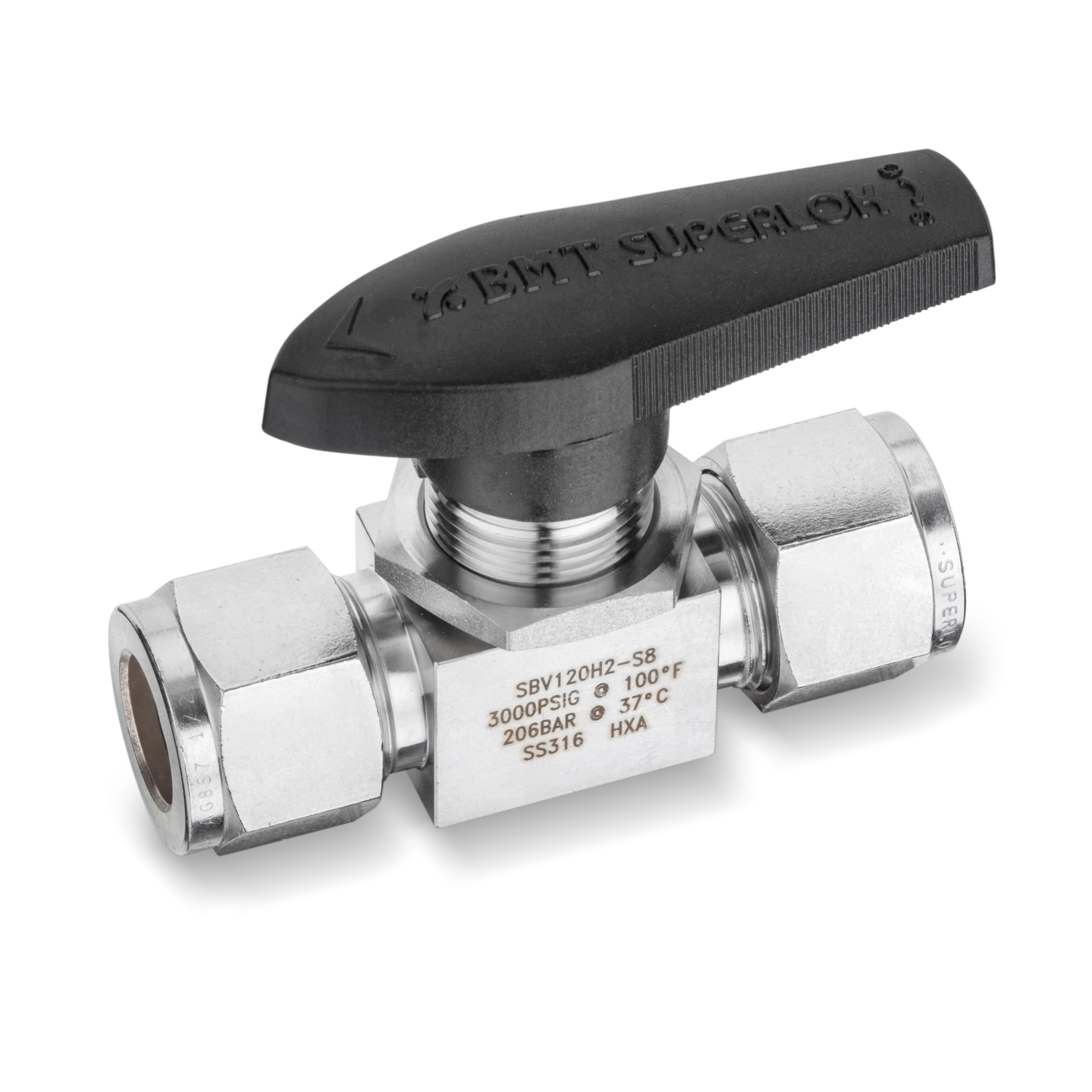
Five things are worth pinning down in writing before a hydrogen order is placed. The grade and, where it matters, the nickel content on the certificate rather than the ASTM minimum. The material condition, annealed or cold worked, and any hardness limit. The full temperature range the part will see, including transients on depressurisation. The design pressure, with the code or standard you are qualifying against named. And the documentation expected: mill certificates, traceability and third-party approvals. Superlok® fittings are listed in 316 stainless steel and other corrosion-resistant alloys, with grade, rating and configuration confirmed per order; ratings are published on the Superlok® pressure rating pages and dimensions in the catalog. Our post on high pressure hydrogen fittings covers the system side. Superlok® also describes its products as having the finest interior surface finish of any tube and pipe fitting on the market, which is a cleanliness and flow claim, not a hydrogen compatibility claim.
Common questions
Is 316 immune to hydrogen embrittlement?
No. Sandia calls 316 “more resistant to hydrogen-assisted fracture than most other austenitic stainless steels,” which is a ranking, not immunity. Annealed 304 tested with hydrogen has shown reduction of area as low as 30% against 75 to 80% without it.
Does hardness matter more than grade?
Both matter. The laboratory reference states high-strength microstructures are significantly more susceptible than low-strength ones, so a hard component in an otherwise suitable alloy family deserves attention.
Do these studies qualify a fitting for hydrogen?
They do not. They are material tests. Component qualification is done against the code or standard governing your system, using the certificates and ratings supplied for the specific part.
Can I reuse the existing panel layout with different fittings?
Superlok® part numbers are cross-referenced to other manufacturers’ catalogue numbers by form, fit, and function only. Confirm material, rating and end connection for the service before anything is approved.
Specifying for hydrogen service?
Send the grade, condition, temperature range and design pressure and we will quote with the documentation named up front.
Superlok North America
Grade on the certificate, not the grade on the drawing.
Sources
- “Technical Reference on Hydrogen Compatibility of Materials: Introduction,” Sandia National Laboratories, US government laboratory reference. Supports the definition of hydrogen-assisted fracture, permeation versus mechanical degradation, and the statement that high-strength microstructures are significantly more susceptible. sandia.gov
- “Technical Reference on Hydrogen Compatibility of Materials: Austenitic Stainless Steels, Type 316 (code 2103),” Sandia National Laboratories. Supports 316 being more resistant than most other austenitic grades, the nickel and strain-induced martensite argument, greatest ductility loss near 200 K, the 1 to 173 MPa pressure span, and the cold-drawn rod result in 69 MPa hydrogen. sandia.gov
- “Technical Reference on Hydrogen Compatibility of Materials: Austenitic Stainless Steels, Type 304 and 304L (code 2101),” Sandia National Laboratories. Supports strain-induced martensite during room temperature deformation and machining, the recommendation to avoid cold working for hydrogen service, reduction of area as low as 30% against 75 to 80%, the ductility minimum near 200 K, and greater loss at higher gas pressure. sandia.gov
- Swagelok® Company, “Hydrogen Embrittlement: Material Selection Guidance,” manufacturer publication. Supports the definition quoted, FCC austenitic grades being generally more compatible, ferritic and duplex being more susceptible, the 12% nickel minimum recommendation for 316, and higher-strength materials experiencing more severe embrittlement. swagelok.com
- “Hydrogen Embrittlement Characterization of 1.4614 and 1.4543 Martensitic Precipitation Hardened Stainless Steels,” Metals, vol. 14, no. 2, 218, 2024, peer-reviewed journal. Supports 316L being among the most resistant stainless steels to hydrogen embrittlement, maraging martensitic grades being sensitive, and susceptibility being linked to high ultimate tensile strength. mdpi.com
Technical note: this is a safety-relevant subject, so the limits of the evidence matter. The Sandia references and the journal study report tests on material specimens under defined laboratory conditions. They establish relative rankings between microstructures and the direction in which temperature, pressure, strength and cold work move susceptibility. They do not establish a safe service envelope, a leak rate, a fatigue life, or a hydrogen rating for any assembled fitting or valve, and none of them tested a Superlok® product. Where a statement above is general rather than grade-specific, it is marked as such in the table. The 12% nickel figure is one manufacturer’s recommendation, not a code requirement. Component suitability for hydrogen service must be established against the code or standard governing the system, using the certificates and ratings issued for the specific part. Superlok® material grade, pressure rating and configuration are confirmed per order.
Superlok® is a registered trademark of its owner. Swagelok® is a registered trademark of Swagelok® Company. Parker® and Hy-Lok® are registered trademarks of their respective owners. All other marks are the property of their respective owners. Superlok North America is not affiliated with, endorsed by, or sponsored by any other manufacturer named here. Cross-references are made by form, fit, and function only.