

SUPERLOK NORTH AMERICA · RACK-LEVEL COOLING
Liquid-Cooled Server Racks and the Loop Behind Them
What happens at the last metre: rack manifolds, blind-mate and hand connections, and where leaks get caught.
Liquid cooled server racks are where manifold ports, hoses and tube fittings meet a technician's hands, one stage past the facility water, coolant distribution unit and secondary loop we mapped in our data center liquid cooling walkthrough. Meta's results release of 21 October 2026 puts third-quarter capital expenditures at $34.91 billion, which gives a sense of the scale of the build-out. According to the Open Compute Project's Open Rack V3 blind mate quick connector specification, Revision 1.0 of 4 June 2024, the connector is a socket on the rack manifold and a plug on the IT chassis. This post stays inside the rack.
Liquid Cooled Server Racks: Manifold, Node, Cold Plate
The Meta Open Rack Frame V3 specification (Revision 1.3, 3 June 2024) says the solution includes blind mate quick connector valves and blind mate manifolds, and that the manifolds mount to the frame with a Blind Mate Liquid Cooling Kit. Lenovo Press, a manufacturer publication on its Neptune water-cooling standards, says each manifold section connects directly to the inlet and outlet connectors of a compute node. Vertiv, also a manufacturer, describes in-rack manifolds with quick-connects compatible with server manufacturers' cold plate designs.
So the rack has three joints in series: the row-to-rack connection, the manifold, and the node connection to a cold plate. The Consulting-Specifying Engineer article by Dynaten's Ardas Sabuncuyan (8 April 2025) covers the hand-made side, and the table sets it beside the OCP connector.
| Point | Blind-mate (OCP BMQC spec) | Hand-made (Consulting-Specifying Engineer) |
|---|---|---|
| Made by | Chassis plug mates with the manifold socket | Tubing or hose run to the server |
| Alignment | Plug floats 4.5 mm axially, 5 mm radially, up to 2.74° angular | Flexible hose managed with clamps or ties |
| Leak control | Spillage limits of 0.025 cm3 at 0 psig and 0.05 cm3 at 50 psig | Dripless quick disconnects, spillage in the server not above 1 cm3 |
| Manifold end | ISO 11926-3 3/4-16 stud end with O-ring | Threaded terminations preferred; tapered threads usually need paste |
The two columns come from different documents and are not a head-to-head test.
Blind-Mate or By Hand
The direction of travel is toward blind-mate. Facilities Dive reported on 9 January 2026 that Nvidia CEO Jensen Huang called the Vera Rubin rack 100% liquid-cooled, with the same 45°C water temperature as Grace Blackwell, and that the new chassis needed no cables or water pipes and took five minutes to assemble, against two hours, 43 cables and six water pipes for Grace Blackwell. That is a nine-month-old CEO statement at a trade show, not a connector specification, and the article does not name a connector type.
The OCP document is the specification. It sets a maximum working pressure of 3.45 bar (50 psig) and a maximum flow of 9 LPM, with a test fluid of a 25% propylene glycol and water mixture and a maximum working fluid temperature of 60°C. Plug and socket components are SS303 stainless steel with EPDM seals. It calls for 120 total wet mate cycles in one section and 240 in a test procedure, and the document does not reconcile the two. Treat any single cycle count as unconfirmed until you read the controlling clause. Engineers weighing a manifold port should also compare the thread: the spec's O-ring stud end is not a tapered pipe thread, so see NPT vs BSPT before anyone mixes standards.
Leak Detection at the Rack
The Open Rack frame specification states that no liquid spillage is allowed during normal and abnormal operating conditions, and sets hydrostatic tests at 3 x 50 psig (150 psig) for normal operation and 2 x 50 psig (100 psig) for abnormal operation. It does not describe sensors. Detection sits elsewhere. The Consulting-Specifying Engineer article says leak detection should be placed throughout the system and report to the CDU, keeps fluid piping separate from IT power and cabling, and recommends an isolation valve on each rack. Lenovo says CDUs should include integrated leak detection monitoring, and its tiered standard asks for basic detection at the Bronze minimum and detection with containment at Gold.
For a design review, that gives three questions. What is the sensor and where is it, because neither OCP document says? What does it do on an alarm, given that rack isolation is recommended? And what does the connector spillage allow before it ever alarms?
Where Small-Bore Hardware Fits at the Rack
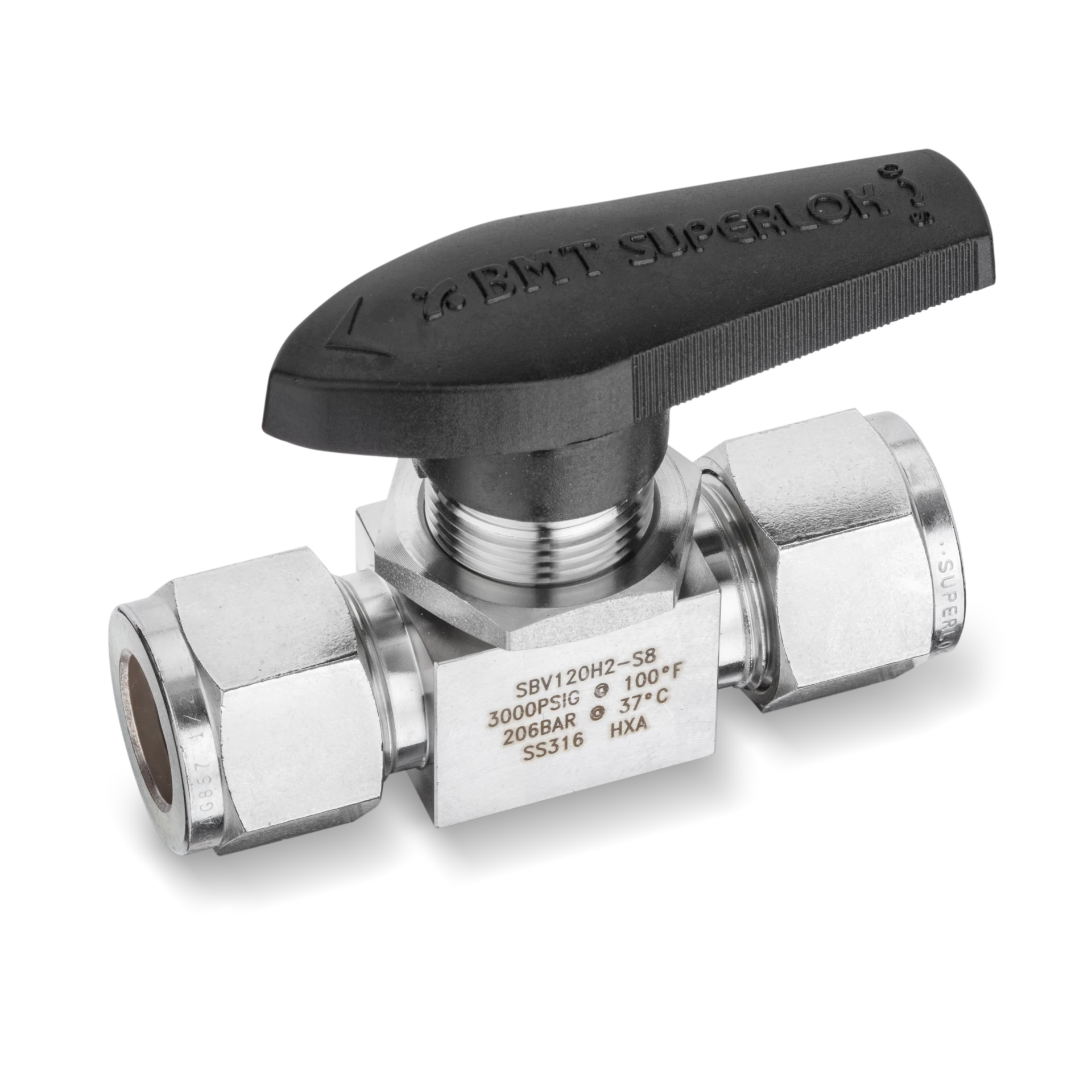
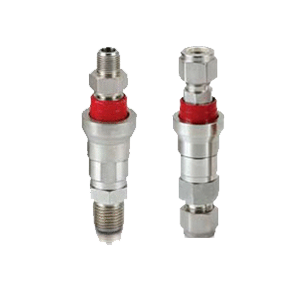
The pressures in these documents are modest, so in our reading the selection drivers are leak-tightness, wetted-material compatibility and drip behaviour rather than pressure rating. Small-bore hardware appears at rack isolation, at test, vent and drain points, and on sensing lines. Superlok® offers ball valves for isolation, quick connects for service points and hose fittings. We do not describe any Superlok® part as meeting the OCP connector specification; that is a statement a supplier has to make for its own part. Stainless steel is the corrosion-resistant choice for wetted small-bore parts in our range, with grade and rating confirmed per order. For assembly practice, use the installation guide; for supply questions, the earlier availability note.
Questions on Rack-Level Connections
Does blind-mate mean zero spillage?
No. The OCP connector specification limits spillage to 0.025 cm3 at 0 psig and 0.05 cm3 at 50 psig.
What pressure does the rack-level hardware see?
The connector specification gives a maximum working pressure of 3.45 bar (50 psig). Your own system pressure comes from the CDU and pump design.
Does the Open Rack specification define leak sensors?
Not in the document we read. It sets a no-spillage requirement and hydrostatic test pressures, and leaves detection to the system design.
Is there a rack power figure in this post?
No. We found no dated primary source for a per-rack kilowatt figure, so we publish none.
Specifying the last metre
Tell us the isolation points, ports and coolant on your rack design and we will return options by line.
SUPERLOK NORTH AMERICA
Small parts carry the coolant, and Superlok® is built around the finest interior surface finish of any tube and pipe fitting on the market.
Sources
- Open Compute Project, "Open Rack V3 Blind Mate Quick Connector Specification (BMQC)," Revision 1.0, 4 June 2024. Supports the socket and plug definition, 3.45 bar and 9 LPM limits, float figures, spillage and air inclusion limits, ISO 11926-3 stud end, SS303 and EPDM materials, test fluid, 60°C and the cycle counts. opencompute.org
- Open Compute Project, "Meta Open Rack Frame V3 Specification," Revision 1.3, 3 June 2024. Supports blind mate manifolds, the mounting kit, the no-spillage statement and hydrostatic test pressures. opencompute.org
- Meta, "Meta Reports Third Quarter 2026 Results," 21 October 2026. Company publication. Supports third-quarter capital expenditures of $34.91 billion. investor.atmeta.com
- Ardas Sabuncuyan, "How to design piping systems for data centers that require liquid cooling," Consulting-Specifying Engineer, 8 April 2025. Supports hose, threaded and dripless quick disconnect practice, the 1 cm3 spillage limit, rack isolation valves and leak detection. csemag.com
- Lenovo Press, "Lenovo Neptune Direct Water-Cooling Standards," LP2018, created or updated 13 September 2024. Manufacturer publication. Supports manifold-to-node connection and leak detection tiers. lenovopress.lenovo.com
- Vertiv, "Understanding fluid networks in liquid-cooled data centers: A complete guide," page dated 10.3.26. Manufacturer publication. Supports in-rack manifold quick-connects. vertiv.com
- Facilities Dive, "No chillers needed for Vera Rubin server racks, Nvidia CEO says," 9 January 2026. Supports the 100% liquid-cooled statement, 45°C and the assembly comparison. facilitiesdive.com
Technical note: These sources establish what the OCP documents specify for a blind mate connector and rack frame, how engineers and two equipment manufacturers describe rack manifolds and leak detection, and what was said about Vera Rubin in January 2026. They do not establish a rack power density, a sensor design, or that any Superlok® part meets the OCP connector specification; the connector document gives two different wet cycle counts, and the Vertiv page date is read from a day-month-year stamp. Material grade and rating are confirmed per order.
Trademark disclaimer: Superlok® is a registered mark of its owner. Meta, Open Compute Project, Lenovo, Vertiv, Nvidia, Facilities Dive and Dynaten are named only to identify cited sources, and their marks belong to their owners. Cross-references are made by form, fit, and function only.