
SUPERLOK NORTH AMERICA · UHP SYSTEMS
UHP Gas Line Installation at Equipment Move-In
The order a crew works from the facility drop to the tool: handle, cut, join, purge, prove, record.
UHP gas line installation is busiest at the moment a process tool is set and its gas runs have to be made up to the facility. According to TrendForce, a trade-press outlet covering the semiconductor industry, Intel announced production equipment installation at Fab 62 in Arizona and is targeting mass production there in late 2028; the item is dated 22 October 2026. Each tool set in that building needs its own run of tube, valves and joints, and every joint is either welded or made up from UHP fittings. This post follows one run in the order a crew works it.
What the Crew Is Connecting at the Tool
At move-in, the run is the stretch between a gas cabinet or valve manifold box and the tool’s own gas panel. One published patent application describes a valve manifold box in which each stick carries a first valve, a regulator valve, a pressure transmitter and a second valve, and states that the stick should be purged before a tool is detached from it. That is one design’s background statement, not a code requirement, but it is a habit worth copying: lay out the drop so it can be isolated and purged without cutting anything.
For the leak proof that follows installation, read helium leak testing a high-purity gas line; this post stops at the tool inlet.
Cleanroom Handling Before Anything Is Cut
The Tube and Pipe Journal, a trade publication, reports that high-purity welding for the semiconductor industry is generally performed in a cleanroom, and quotes a contractor saying that keeping contaminants out of the stainless steel tubing is essential. Stainless steel is corrosion-resistant, but a clean bore is decided before the torch lights. Our advice: keep each part bagged until its position in the run is reached, and open bags at the work location.
Packaging matters because of how parts are made. Superlok® states on its UHP diaphragm valve page that its electro-polished, D.I. water cleaned valves are assembled, tested and packaged in a certified clean room. That page does not describe fitting packaging, so ask for the packaging of each fitting part number you order; it is confirmed per order. Parts should also arrive with paperwork: SEMI lists F20 as its 316L specification for metallurgical cleanliness and composition, and our sample material test report shows the kind of document to expect. See also 316 vs 316L.
Cutting and Facing the Tube
For compression connections in gas service, the Superlok® installation guide, a manufacturer publication, says to cut tubing square to its centerline, deburr the inside and outside of the cut end with a sharp deburring tool, and use tubing that is round and free of surface defects. A weld joint asks for the same discipline for a different reason. SEMI describes F78 as covering autogenous butt joint welds, and an autogenous weld adds no filler metal, so the joint has only the two tube ends to work with. A burr or an angled cut stays in the joint.
Access decides the tooling. The Tube and Pipe Journal says the orbital machines at the contractor it profiled handle tube from 1/16 to 4 in., and that compact heads reach tight spots.
Welded Joint or Metal Seal Connection
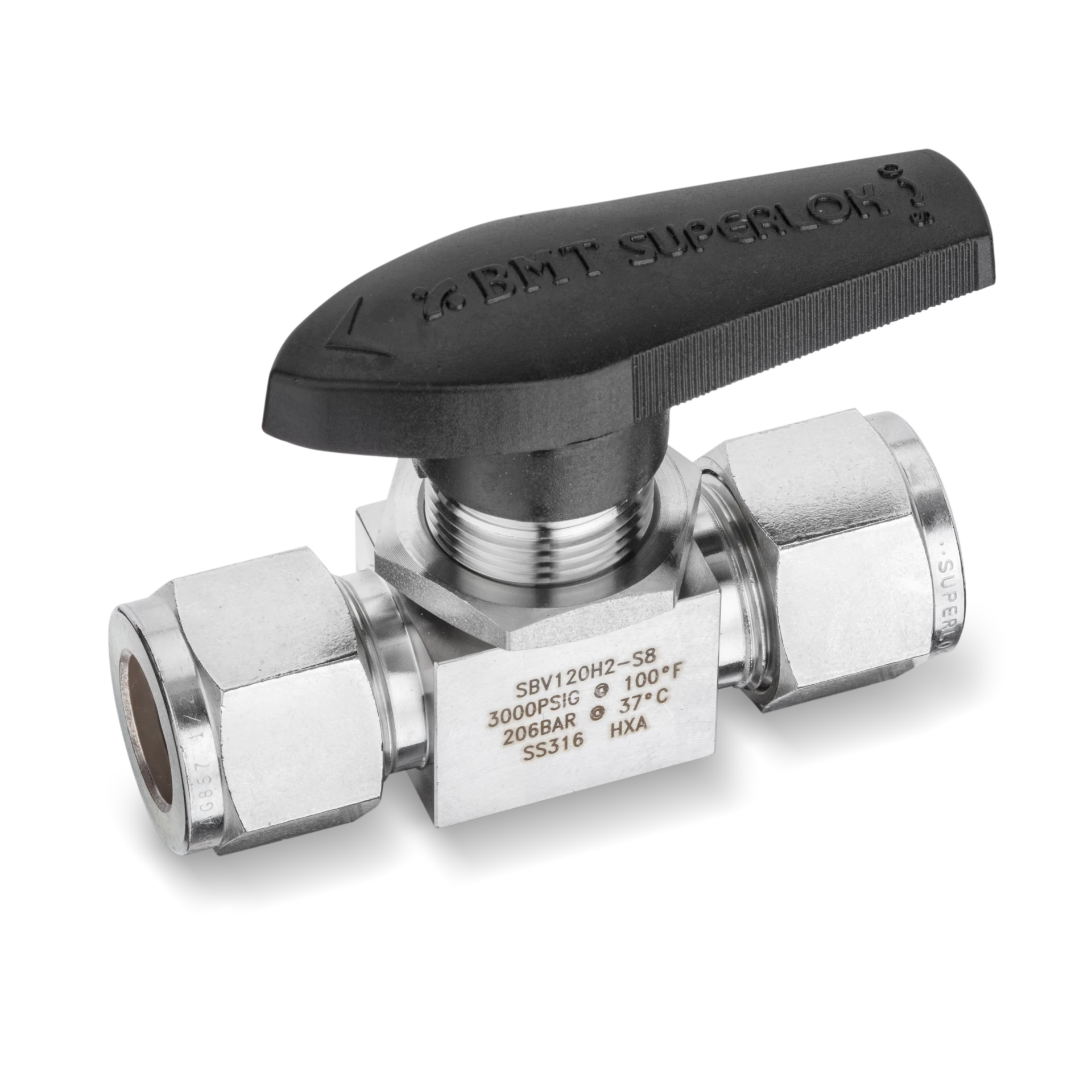
A welded joint is permanent and carries no seal part. A metal seal connection can be opened again. Where the tool will be serviced or moved, a separable joint at the tool inlet is often the sensible place for it. The range includes the UHP gasket, listed in 316 stainless steel, the UHP TBW connector for butt welds, and the UHP male weld gland. The gasket page does not state a reuse rule, so get the make-up and reuse instruction for each gasket in writing before the crew starts, and do not assume it.
Welding speed is a real input to the schedule. The profiled contractor puts a machine weld at about three minutes against about one minute by hand, but says the machine holds its pace through a shift and suits hundreds of identical welds. That is one shop’s figure, not a benchmark.
The UHP Gas Line Installation Sequence at the Tool
| Step | What happens | Basis |
|---|---|---|
| 1. Stage | Check parts and paperwork against the isometric; keep bags closed | Cleanroom practice; SEMI F20 listing |
| 2. Cut | Square cut, deburred inside and outside | Superlok® installation guide |
| 3. Join | Orbital weld, or metal seal make-up per the written instruction | SEMI F78 listing; part pages |
| 4. Purge | Argon inside and outside during the weld; purge the stick before any tool is detached | Tube and Pipe Journal; patent record |
| 5. Inspect | Sight check of every weld; radiography only where code or customer asks | Tube and Pipe Journal |
| 6. Test | Helium leak test to the project specification | Tube and Pipe Journal; our earlier post |
| 7. Record | Tie each joint to its result and its material lot | Recommended practice |
Sequence and checks are drawn from the cited sources; no limit values are stated because none of them set one.
Purging, Proving and Closing Out
On purge, a US patent record for an orbital welding purge adaptor says an inert gas flow is needed on both the outside and the inside of the tubes, so that oxygen does not cause adverse metallurgical and contaminating effects, and warns that air leaks could cause weld failure. The Tube and Pipe Journal reports pure argon used for external and internal purges, and says orbital welds generally finish cleaner because gas covers the tube longer. Neither source gives an oxygen or moisture limit, so take that number from your specification.
On proof, the same journal reports that every weld at that shop gets sight confirmation and then a helium spectrometer test. On records, no cited source sets a format. Our recommendation: each entry names the joint as drawn, the method, the purge, the inspection and leak test results, and the material lot, so a failed test traces to one joint and one lot.
Questions from the Hook-Up Crew
Weld or metal seal at the tool inlet?
Weld where the joint will never open; use a metal seal where the tool will be pulled for service. The drawing decides.
Which standard governs the weld?
Your project specification names it. SEMI lists F78 as the practice for gas tungsten arc welding of fluid distribution systems in semiconductor applications, current revision F78-0624.
Does an orbital weld save time over a hand weld?
Not per joint, on the one contractor figure above. Its value is repeatability.
Can the fittings arrive packed for cleanroom use?
Packaging is confirmed per order for each part number. Superlok® states its UHP diaphragm valves are packaged in a certified clean room.
Give us the drop list for the tool
Tube size, joint type and quantity for each drop are enough for us to match welded and metal seal parts to your drawing.
SUPERLOK NORTH AMERICA
A gas line is only as clean as its bore, and that is where Superlok® puts its work: the finest interior surface finish of any tube and pipe fitting on the market.
Sources
- TrendForce, news item, 22 October 2026. Supports Intel announcing that production equipment installation has begun at Fab 62 in Arizona and the reported late 2028 mass production target. trendforce.com
- Corey Stulce, "Optimizing and economizing orbital welding for pipe projects," The Tube and Pipe Journal (via The Fabricator), 14 July 2020. Supports cleanroom welding, contaminant control, tube size range, argon internal and external purge, weld times, sight confirmation and helium testing. thefabricator.com
- US patent 7,520,538, "Orbital tube welding purge adaptor," filed 14 January 2005, granted 21 April 2009, background section (patent record, publication 20060157535). Supports the need for an inert purge inside and outside the tubes and the risk of air leaks. patents.justia.com
- US patent application 20220336235, "Valve box module, semiconductor device manufacturing system and method for manufacturing semiconductor device," published 20 October 2022. Supports the stick layout and the statement that a stick should be purged before a tool is detached. patents.justia.com
- SEMI, store listing for SEMI F78, practice for gas tungsten arc welding of fluid distribution systems in semiconductor manufacturing applications. Supports its scope (autogenous butt joint welds) and the current revision F78-0624. store-us.semi.org
- SEMI, store listing for SEMI F20, specification for 316L stainless steel for semiconductor applications. Supports its scope of metallurgical cleanliness and composition. store-us.semi.org
- Superlok North America, installation guide (manufacturer publication). Supports square cutting and inside and outside deburring for gas systems. superloknorthamerica.com
- Superlok North America, UHP diaphragm valves page (manufacturer publication). Supports electro-polished, D.I. water cleaned valves assembled, tested and packaged in a certified clean room. superloknorthamerica.com
- Superlok North America, UHP gasket page (manufacturer publication). Supports the 316 stainless steel listing and the absence of a stated reuse rule. superloknorthamerica.com
Technical note: These sources establish the reported Fab 62 timing, what one contractor does on orbital welding, purge and inspection, the stated scope of two SEMI standards (from store listings, not the standards), and Superlok® installation and packaging statements. They do not establish a purge oxygen limit, a weld acceptance criterion, a gasket reuse rule or a record format; the cleanroom handling advice and the record fields are our recommended practice, not a sourced requirement. Weld times are one shop’s figures. Where a patent record is cited it supports only its own background statement. Material grade and pressure rating are confirmed per order.
Trademark disclaimer: Superlok® is a registered mark of its owner. TrendForce, Intel, SEMI, The Fabricator and The Tube and Pipe Journal are named only to identify the sources cited, and their marks belong to their respective owners. Cross-references are made by form, fit, and function only.