

Superlok® USA · Fitting Fundamentals
Compression vs Flare Fittings: Two Ways to Seal a Tube
One reshapes the tube end into a cone. The other leaves the tube round and swages a ferrule onto it, and that choice sets your tooling and your remakes.
A flare fitting cold works the tube itself into a cone and clamps that cone between two machined surfaces. A compression fitting leaves the tube cylindrical and drives a ferrule into the outside diameter. They are not variations on each other. According to SAE International, the standards body that publishes AS4841D, that standard covers 37 degree flare fittings “for use with 37 degree external cone, spherical nose, and seal ring fittings in all types of aerospace fluid systems”, which shows how firmly the flare is written into some industries. In instrumentation the compression joint took over long ago. Telling the two apart on sight, and knowing why each is where it is, saves guesswork at the bench.
How each one makes its seal
A flare joint changes the shape of the tube. The end is opened outward into a cone and a nut pulls it against a matching cone in the fitting body, so the seal is metal on metal across a face you formed yourself. A flare nut draws the formed cone against the fitting cone, and that metal to metal contact is the seal. The tube is part of the seal, so the quality of the flare is the quality of the joint.
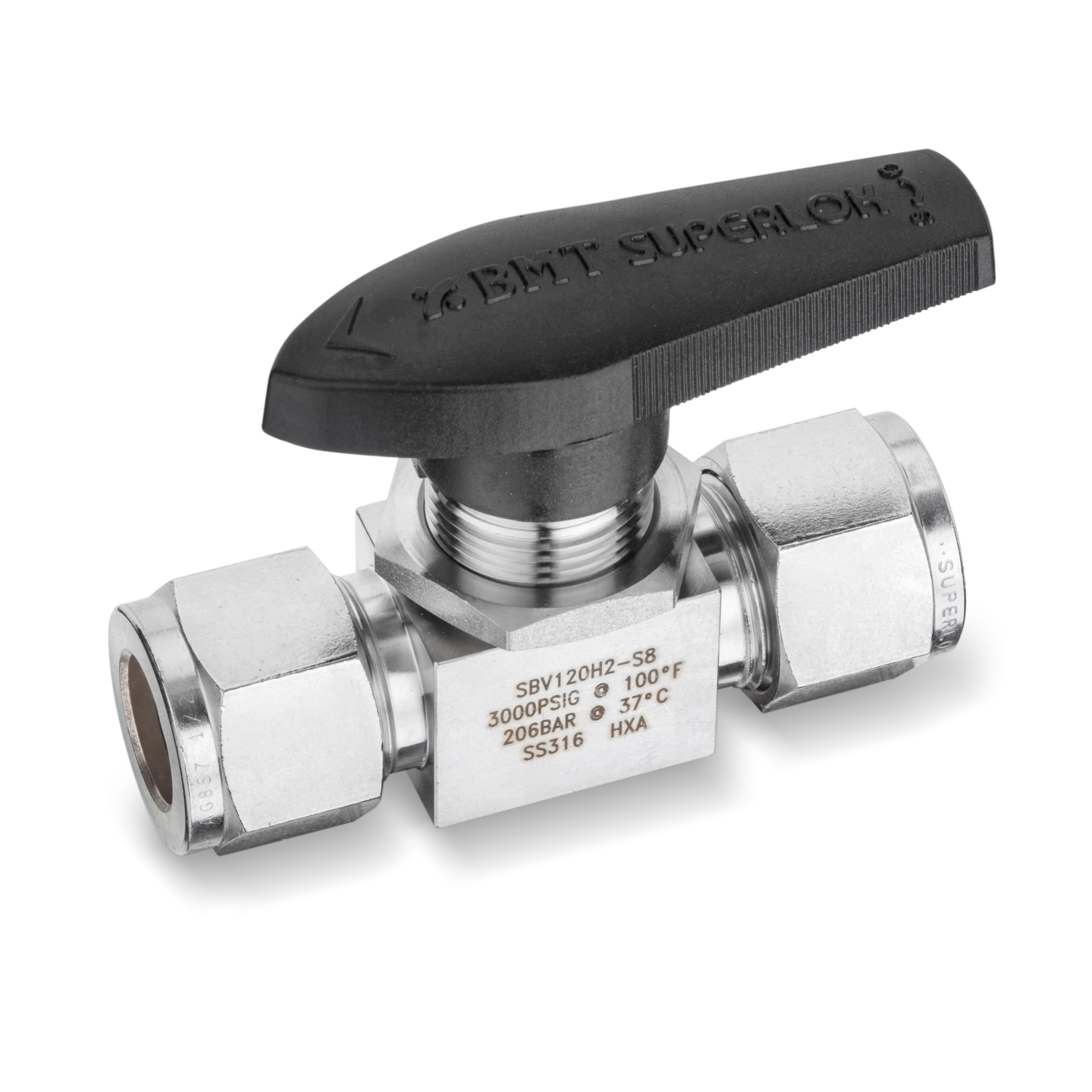
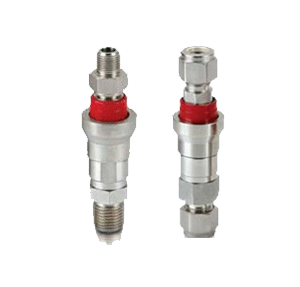
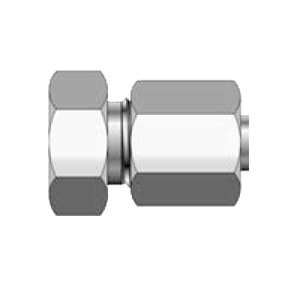
A compression joint leaves the tube alone until assembly. The tube is cut square, deburred and pushed in until it bottoms on an internal shoulder, and tightening the nut drives a ferrule along a taper onto the tube outside diameter. That one action seals against the body and grips the tube. Superlok® sets out the sequence in its own installation guide, a manufacturer document: insert so that “the tubing is in contact with the shoulder of the fitting”, mark the nut, “tighten the nut 1-1/4 turn”, then confirm with a gap inspection gauge, where “if the gauge will not enter the gap, the fitting is sufficiently tightened.”
Tooling, and who can do the work
Flaring needs a flaring tool. The tool clamps the tube in a die and forces a cone into the end of it, cold working the metal outward into the flare. It has to be the right angle and in good condition, working on square-cut tube. A split, off-centre or under-formed flare is scrap, and the repair is to cut it off and start again, which shortens the run.
A compression joint needs a cutter, a deburring tool, two wrenches and a gap gauge. Nothing is formed on the tube, so there is no forming tool to calibrate. That is much of why compression fittings spread through instrument work, where one technician may make dozens of joints in a cabinet and every one has to come out the same. Our note on analyzer sample systems covers why repeatability outranks raw pressure capability there.
Where the flare is the standard
Refrigeration and air conditioning are flare territory. SAE J513 “covers complete general and dimensional specifications for refrigeration tube fittings of the flare type” and says those fittings “are intended for general use with flared annealed copper tubing in refrigeration applications.” That is the 45 degree family, and a flare there is often preferred because it is mechanically separable without an open flame.
Fluid power sits on the 37 degree flare. JIC fittings use a 37 degree seating surface under SAE J514, and the same geometry reaches aerospace through AS4841D. One warning carries across all of it: the two angles do not mate, so a 45 degree flare and a 37 degree fitting will never seal against each other. Never settle an angle by eye.
Where compression dominates
Instrumentation is the compression fitting’s home ground: gauge and transmitter hook-ups, sample and analyzer lines, impulse lines, panel work and small bore tubing in process and utility service. The tube end is not deformed, so one fitting can serve a range of wall thicknesses, and the bore is not disturbed by forming, which matters when a sample must reach an analyzer unchanged. Superlok® states that its components are made with the finest interior surface finish of any tube and pipe fitting on the market. Corrosion-resistant grades are the default here, which is why 316 stainless steel is the listed material across most of the tube fittings range and the wider fittings catalogue.
| Aspect | Flare joint | Compression joint |
|---|---|---|
| Sealing surface | Cone formed on the tube, clamped to a cone in the body | Ferrule swaged onto the tube outside diameter |
| Tube prep | Cut, deburr, then form the flare | Cut square, deburr, insert to the shoulder |
| Tooling | Flaring tool of the correct angle, plus cutter | Cutter, wrenches, gap inspection gauge |
| Published standards | SAE J513, SAE J514 Part 1, SAE AS4841D | SAE J514 Part 2 covers the flareless family; instrument fittings follow the maker’s catalogue data |
| Typical homes | Refrigeration copper, hydraulic and fuel lines, aerospace fluid systems | Instrument and analyzer tubing, panels, impulse lines |
| Taking it apart | Sound flare can be re-nutted; damaged flare is cut off and reformed | Designed to be remade on the same tube end per the maker’s instructions |
Scopes are quoted from the published SAE documents in the sources. Ratings, materials and dimensions for any specific part are confirmed per order.
Remake and reuse
Compression fittings are built for reassembly. The Superlok® guide gives the method: finger tighten the nut, bring it back with a wrench to the original marked position, feel for “a slight change of resistance”, then “tighten the nut slightly more”. The ferrule is already formed, so you are re-seating a known geometry rather than making a new one. No manufacturer publishes an unlimited remake count, so follow the instruction sheet for the part in hand.
A flare behaves differently, because it is a permanent feature of the tube. Re-nutting a clean, unscored flare is routine. A flare that has been over-torqued, scored by the seat, cracked at the lip or work hardened by repeated clamping is not recoverable, and the fix is to remove it and form a new one. On a short stub with no slack left, that becomes a re-run, so leave tube length for it.
Telling which one is on an existing line
Depressurise, back the nut off and look at the tube rather than the fitting. A tube end that spreads into a visible cone, with nothing loose behind it, is a flare. A tube end that is still cylindrical, with one or more rings bitten into the outside diameter, is a compression joint. Second check: a compression nut releases a ferrule when it comes off, while a flare nut has a smooth bore and releases nothing.
Look into the body too. A flare body has an open cone machined in the bore; a compression body has a shoulder for the tube plus a tapered ferrule seat. Context helps: annealed copper on refrigeration work is very likely 45 degree flare, and small bore stainless steel instrument tubing in a panel is very likely compression. If the line is flare, measure the angle with a gauge. If you are matching a compression joint, keep the whole joint within one manufacturer’s parts and use the fitting cross-reference tool to find the Superlok® part that matches by form, fit and function, as we set out in our note on whether Parker® and Swagelok® fittings interchange. For general plant work the process piping pages show where each family lands.
Common questions
Can I put a flare nut onto a compression body, or the reverse?
No. One body has a cone seat for a formed tube, the other a shoulder plus ferrule taper, and the nuts are made for their own family. Treat them as separate systems.
Which style holds more pressure?
That is the wrong question to ask of a seal style. Working pressure comes from the specific fitting, the tube material and the wall thickness, and from published tables. Start with the pressure rating data and the catalog for the part you intend to buy.
Why did instrumentation settle on compression?
Nothing has to be formed on the tube. A technician with a cutter, wrenches and a gap gauge can make consistent joints across a cabinet, and the bore is left undisturbed.
Do I need a flaring tool for just a few joints?
If the line is flare, yes, and it must be the correct angle. The 45 degree refrigeration form and the 37 degree fluid power form are not interchangeable, so one tool does not cover both.
Can I identify a flare angle by eye?
No. Use a gauge or a known good mating part. A mismatch between 37 and 45 degrees leaks under pressure even when the nut feels tight.
Need the Superlok® part that matches your line?
Send the existing callout and we will return the form, fit and function match, with grade and rating confirmed per order.
Superlok® USA
Instrumentation fittings and valves, listed in corrosion-resistant 316 stainless steel, documentation confirmed per order.
Sources
- SAE International, “AS4841D: Fittings, 37 Degree Internal Flare, Fluid Connection, Procurement Specification,” standard abstract, supports the 37 degree flare requirement in aerospace fluid systems. saemobilus.sae.org
- SAE International, “J513: Refrigeration Tube Fittings, General Specifications,” standard scope, supports the 45 degree flare family and its use with annealed copper tubing. standards.globalspec.com
- SAE International, catalogue listing for “J514/1: Metallic Connections for Fluid Power and General Use, Part 1: 37 Degree Flared Fittings,” cited for the existence and title of the 37 degree flared fitting standard. The scope text was not retrievable from this page. sae.org
- SAE International, “J514/2: Flareless Hydraulic Tube Fittings,” standard scope, supports the published flareless fitting family. saemobilus.sae.org
- Superlok® USA, “Superlok® Installation Guide,” a manufacturer publication, supports the assembly and remake sequence quoted here. superloknorthamerica.com
Technical note: the SAE documents cited here define flare geometry, scope and application within their own families. They do not rate any particular fitting and they do not establish that one seal style outperforms another. Nothing above is a pressure rating, a material certification or an interchange statement for a specific part number. Material grade, pressure rating and documentation for Superlok® products are confirmed per order.
Trademark disclaimer: Superlok® is a registered trademark of its owner. Swagelok® and Parker® are registered trademarks of their respective owners. No affiliation, sponsorship, approval or endorsement by any of those companies is claimed or implied, and nothing above should be read as saying any Superlok® product is the same as, equivalent to, compatible with or a replacement for another manufacturer’s product. Cross-references are made by form, fit, and function only.