

SUPERLOK® NORTH AMERICA · VALVE SELECTION
Plug Valve vs Ball Valve for Instrument Service
Two quarter-turn shutoffs compared by mechanism, sealing, flow path, torque, throttling and maintenance.
Most instrument lines need a quarter-turn shutoff somewhere, and the choice usually comes down to a plug valve vs ball valve. Both turn 90 degrees, both are manual, and both are often used for isolation. They differ in how the closure is built, how it wears and what it asks of the technician. For the plug side of the range, see our plug valves page. According to Gemini Valve, a valve manufacturer and supplier, so this is a manufacturer publication, a plug valve uses a conical, tapered, hollow plug that rotates to let media pass through a rectangular passage, while a ball valve pivots a ball with a bore through it.
Plug valve vs ball valve: how each one closes
Projectmaterials, an engineering reference published by a software company for piping stockists, describes the plug as a conical or cylindrical element that rotates 90 degrees inside the body. A ball is a sphere with a bore that either floats between seat rings or turns on trunnion bearings. Wastewater Digest, a trade publication, groups plug, butterfly and ball designs together as quarter-turn valves, which is why they are so often compared.
The two sources do not agree on sealing, and the disagreement is instructive. Gemini Valve credits the plug with a larger sealing surface and bubble-tight shutoff, and rates the ball as good with a smaller sealing area, adding that newer sealants and seal injection narrow the gap. Projectmaterials rates a soft-seated ball as excellent, citing PTFE seats, and rates a lubricated plug as good. The practical reading is that shutoff depends on the specific seat and seal design, not on the valve family. Check the leakage class of the actual valve, not the category.
| Factor | Plug valve | Ball valve |
|---|---|---|
| Mechanism | Tapered plug rotates in the body | Ball with a bore pivots between seats |
| Sealing | Bubble-tight (Gemini); good when lubricated (Projectmaterials) | Good (Gemini); excellent with soft seats (Projectmaterials) |
| Flow path | Rectangular port, full-port (Gemini); moderate pressure drop (Projectmaterials) | Round bore, low pressure drop |
| Torque | Higher, from plug-to-body friction | Lower, from ball-to-seat contact |
| Throttling | Not suitable | Not suitable |
| Maintenance | Re-lubricate or replace sleeve; plugs can be removed and cleaned | Replace seat rings; standard balls are replaced, not repaired |
Condensed from the Gemini Valve and Projectmaterials comparison pages. Neither is specific to instrumentation sizes.
Flow path and torque in small bores
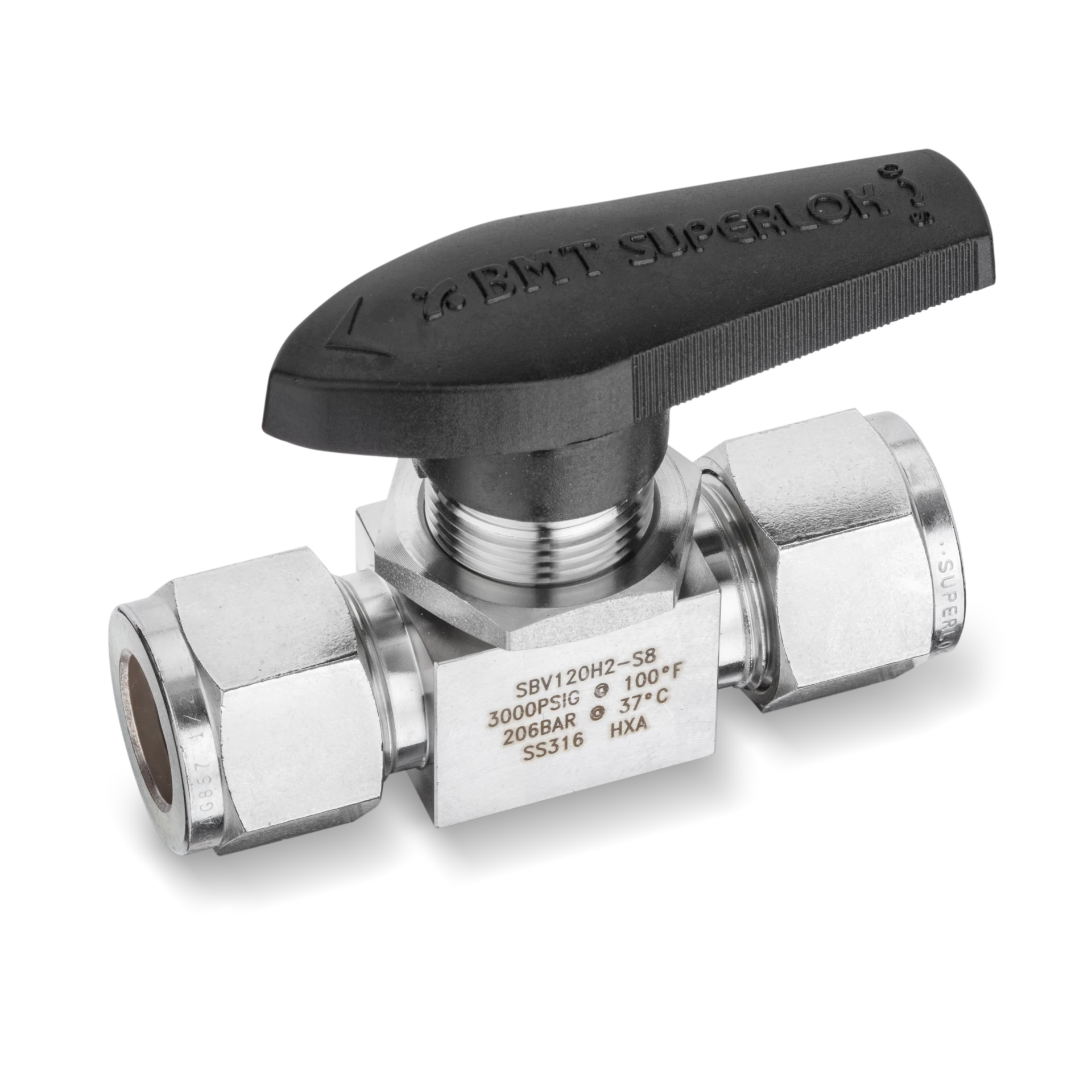
Both sources agree on torque: the plug is harder to turn. Gemini Valve cites high torque requirements for plugs and low for balls, and Projectmaterials attributes the plug’s torque to friction between plug and body. On flow path they differ again, with Gemini describing a full-port plug and Projectmaterials describing a rectangular port with moderate pressure drop. Port shape varies by design, so read the Cv and orifice for the exact model. On our own range, the SPV listing gives Cv and orifice data by model, and the ball series are listed with pressure ratings of 3000 psi for the SBV120, up to 6000 to 10000 psi for the SBVH360 and SBT series. For the full ball range, see ball valves.
In a small-bore instrument line, torque matters less than it does on a large process line, because the handle is small and the stem load is low. What matters more is repeatability: a valve that turns smoothly the thousandth time. That is our engineering reading, not a finding from either source.
Throttling: neither one
Gemini Valve says plain plug valves are not suitable for flow regulation, and also says ball valves are not suitable for throttling. Its plug-valve guide adds that a plug must be fully open for flow, because partial positions can damage the valve. If the job is to meter or trim flow, use a valve built for it. We covered that choice in needle valve vs ball valve, so we will not repeat it here.
Maintenance: lubricant or seat ring
Gemini Valve describes two plug constructions. Lubricated plugs carry a lubricant chamber that provides constant lubrication to the plug. Non-lubricated plugs use an elastomeric sleeve between plug and body, which the page says cannot handle high temperatures. Projectmaterials warns that neglecting the lubrication schedule on a lubricated plug can cause the plug to seize. A ball valve has no such schedule, but when its seats wear, the usual answer is replacement; Gemini notes standard balls are designed to be replaced, not repaired, and that three-piece versions are the serviceable option.
Our SPV is listed as a one-piece body design in 316 stainless steel, a corrosion-resistant grade, rated to 3000 psig (206 bar) at 100°F and listed for -10°F to 400°F. The catalog page does not name the seat or seal material, so ask for it before you specify. The full specification table is on the SPV plug valves catalog page, and the plug valve page also lists a 6000 psi rising plug series, the SRPV.
Choosing for instrument service
This section is our judgment, drawn from the comparison above. Choose a ball valve when the line is clean, the valve is operated often and you want low torque and a soft seat. Choose a plug valve when the media is sticky or carries solids; Gemini Valve lists abrasive and sticky media among plug applications, and says plugs can be removed and cleaned. Either way, put the valve where the isolation duty is defined: our root valve vs isolation valve post explains where that is. Match temperature to the seal, and confirm the stem and end connections against the pressure rating page.
Questions from instrument techs
Which seals tighter, a plug or a ball?
The sources disagree. Gemini Valve favors the plug on sealing surface area, while Projectmaterials rates a soft-seated ball as excellent. Compare the stated leakage class of the specific valves.
Can either valve throttle flow?
Neither, per Gemini Valve. Use a valve designed for regulation.
Why does a lubricated plug need a schedule?
Projectmaterials says a neglected lubrication schedule can cause the plug to seize, so the lubricant chamber is part of the maintenance plan.
Is a quarter turn always 90 degrees?
Quarter-turn means a 90 degree rotation. Projectmaterials describes the plug as rotating 90 degrees, and Wastewater Digest classes both plug and ball designs as quarter-turn valves.
Tell us the line, we will check the valve
Send the media, pressure and temperature and we will confirm the match.
SUPERLOK® NORTH AMERICA
One more thing worth knowing: the finest interior surface finish of any tube and pipe fitting on the market.
Sources
- Gemini Valve, “Plug Valves vs. Ball Valves: Key Differences & Applications” (valve manufacturer and supplier publication). Supports mechanism, sealing, flow path, torque, throttling, maintenance. geminivalve.com
- Gemini Valve, “Plug Valve Basics: How They Work and Where They’re Used” (same manufacturer). Supports partial-open caution, lubricated and non-lubricated types, applications. geminivalve.com
- Projectmaterials, “Plug Valve vs Ball Valve,” Editorial Team, 18 March 2023 (software company reference for piping stockists). Supports rotation, sealing ratings, torque, maintenance, lubrication warning. blog.projectmaterials.com
- Wastewater Digest, “Quarter-Turn Valves,” 18 September 2019 (trade press). Supports grouping of plug and ball valves as quarter-turn valves. wwdmag.com
- Superlok® North America, SPV plug valve catalog page and ball valve page. Supports SPV and ball series ratings and materials. superloknorthamerica.com
Technical note: the Gemini Valve pages are manufacturer publications and the Projectmaterials page is a general reference; neither addresses instrumentation tube sizes, leakage classes or specific pressure ratings, and they disagree on sealing and port shape. The SPV page does not name seat or seal materials, and the catalog lists a 3000 psig rating and a 6000 psi SRPV series. The choosing section is our judgment. Grade and rating confirmed per order.
Trademark disclaimer: Superlok® is a registered mark of its owner. Gemini Valve, Projectmaterials and Wastewater Digest are names of their respective owners, used only to identify sources, with no affiliation implied. Cross-references are made by form, fit, and function only.