

SUPERLOK® NORTH AMERICA · QUICK CONNECT ENGINEERING NOTES
Quick Connect vs Quick Disconnect: Same Part, Different Words?
The name on the coupling tells you little. The valves, the shutoff and the flow path tell you what it does.
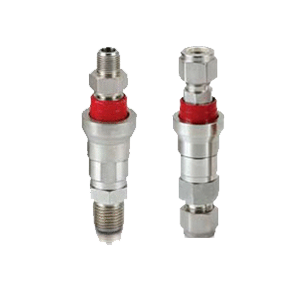
Quick connect vs quick disconnect reads like a choice between two product types, but the makers’ own literature uses the words for one family of couplings. According to Beswick Engineering’s “The Basics of Quick Disconnects,” a manufacturer publication, these fittings are “also known as quick connects or quick release couplings.” What separates one design from another is not the verb in its name. It is whether the halves carry valves, how many of them do, and how much flow area the body leaves open. Superlok® describes its own quick connects as push-pull couplings that join and part lines without tools, with plugs and bodies offered valved or unvalved.
Quick connect vs quick disconnect: how the makers use the words
Read enough catalogs and the pattern is plain: the term follows the publisher’s habit. The Swagelok® catalog MS-01-138 titles itself “Quick-Connects” and, in the text retrieved for this post, never uses “quick disconnect.” The Parker® Quick Disconnect Couplings Core Products Guide uses the other word in its title, while Parker®’s Quick Coupling Safety Guide says “quick coupling” and “quick action coupling” throughout. CPC, a coupling maker, uses quick connect and quick disconnect as general names for the same family. Fluid Power World’s primer calls the parts quick-connect couplings and also “push-to-connect,” and ISO 7241 avoids both terms in favor of “quick-action couplings.”
Superlok® follows the quick connect habit. Its product page and its datasheet both use that language, and the datasheet describes a push-pull connection. The practical consequence is that a search box, a purchase requisition or a drawing note that says “quick disconnect” is not wrong. It is just incomplete. Neither word states the series, the size, the end connection or the valving, and those four details are what a supplier needs.
What actually distinguishes one design from another
Valving comes first. The Superlok® page says valved connectors open as the halves join and shut off as they part, to limit the loss of liquids or gases. An unvalved coupling has no such action. A Power & Motion Technology staff report on couplings notes that unvalved types have low pressure loss, and that valved couplings can generate a much higher pressure drop. Beswick adds the safety side: designs without shutoff are generally limited to low-pressure air or other non-hazardous gases, because nothing contains the fluid on disconnection.
Shutoff arrangement comes second. Beswick describes a single shutoff fitting as one with a valve in its internal half only, which suits filling or evacuating a chamber before the line is parted, and a double shutoff fitting as one with valves in both ends. The Superlok® datasheet uses the same split for the SQC series under the codes SO and DO. Flow path comes third. The datasheet lists SQC1 flow coefficients of about 0.08 to 0.4 depending on end connection and shutoff type, and describes the SFQC series as a full flow, ball-lock design. Its SFQC section does not mention shutoff valves, so the shutoff question for that series goes to sales, not to an assumption.
| Question | What the sources say | What to write on the order |
|---|---|---|
| Valved or unvalved? | Valved halves close on parting; unvalved halves have lower pressure loss | The valving of plug and body |
| How many shutoffs? | SO is one side, DO is plug and body (SQC datasheet) | SO or DO in the part number |
| How much flow? | Flow coefficient varies by end connection and shutoff type | Required flow, not just tube size |
| What locking action? | Push-pull on SQC, ball-lock on SFQC | Series and size |
Ball-locking designs have their own caution. Parker®’s safety guide says ball locking couplings can disconnect unintentionally if dragged over obstructions or if the sleeve is bumped.
Hydraulic and instrumentation series are separate products
The same datasheet covers three families. The SHQC series is listed as a hydraulic quick connector, with an automatic shutoff valve in both socket and plug and compliance with ISO 7241 series B. The ISO page says that standard sets interface dimensions and basic performance requirements for two hydraulic series, and series B is mainly used in North America and the chemical industry. The SQC series is the instrumentation line for gas and liquid service, and the SFQC series is the full flow line. A coupling called a quick connect in one drawing could therefore be any of three very different parts, which is why the series code matters more than the noun.
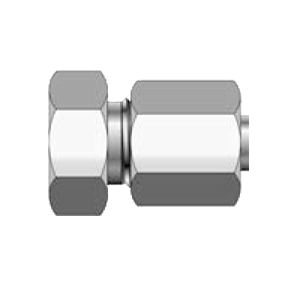
Pressure follows the series, not the name. At 70 °F the datasheet’s coupled ratings fall from 3000 psig on SQC1 to 750 psig on SQC3, on a 316 stainless steel body with an FKM O-ring, and it warns that the components of a given configuration may cap the pressure and temperature range. For the end connections that join the coupling to your tubing, see the tube fittings range. Superlok® states that its fittings offer the finest interior surface finish of any tube and pipe fitting on the market, and a corrosion-resistant 316 stainless steel body is the datasheet’s default material, with brass as the option.
Reading the part number instead of the name
The ordering code carries everything the name leaves out: series (SQC1 to SQC3, or SFQC2 to SFQC5), P for plug or B for body, a connection letter, the size, the shutoff type for SQC, and a material suffix, with blank meaning 316 stainless steel and B meaning brass. The catalog pages for SQC quick connect bodies and SFQC full flow quick connect bodies are the places to start. For tubing around the coupling, our analyzer sample system fittings post is the companion. Pressure ratings for the wider range are on the pressure ratings page. If the base metal is the open question, 316 vs 316L explains what the letter changes.
Questions on the two names
Is a quick disconnect different from a quick connect?
Not as a product class. Beswick and CPC use both names for the same kind of coupling, and Fluid Power World uses both within one article. Differences come from valving, shutoff and flow.
Does a valved coupling flow as freely as an unvalved one?
Not according to the trade press. Power & Motion Technology reports that valved couplings can generate a much higher pressure drop than unvalved designs.
Is SFQC the same thing as a double shutoff SQC?
No. The datasheet gives SO and DO options for SQC only. SFQC is described as full flow with a ball-lock mechanism, and its section does not state a shutoff type.
Can I use a hydraulic series on an instrument line?
Series are rated separately, and the datasheet says to consult Superlok® sales for a specific application. Have the fluid, pressure, temperature and tubing size ready.
What should a requisition say?
Series, plug or body, connection, size, shutoff type and material. The word before “coupling” adds nothing the part number does not.
Need the right half, not the right word?
Send the series, size, end connections and service conditions, and our team will confirm the pair.
SUPERLOK® NORTH AMERICA
Specify the part, not the label.
Sources
- Beswick Engineering, “The Basics of Quick Disconnects” (undated manufacturer publication). Supports the equivalence of the terms, shutoff definitions and the limits on designs without shutoff. beswick.com
- Superlok® North America, quick connector datasheet BMT-CQC Rev. 6 (June 2019). Supports series, valved and unvalved options, SO and DO, ISO 7241 series B, coupled ratings, materials and the component caveat. (superloknorthamerica.com/wp-content/uploads/2026/03/, file BMT_QUICK_CONNECTOR_SHQCSQCSFQC_EN_-R6_190601-7_compressed.pdf)
- Superlok® North America, quick connect product page. Supports push-pull action and the valved shutoff description. (superloknorthamerica.com/superlok-quick-connect/)
- Swagelok®, “Quick-Connects, QC, QF, QM, and QTM Series (MS-01-138),” Rev. V, January 2025. Supports the terminology observation only. swagelok.com
- Parker®, “Quick Coupling Safety Guide” and “Quick Disconnect Couplings Core Products Guide” (04/25). Support the terminology observation and the ball-lock caution. safety guide, core products guide
- CPC, “Quick Connects Disconnects.” Supports use of both names for one product family. cpcworldwide.com
- Mary Gannon, “What are quick-connect couplings?”, Fluid Power World, 31 August 2016. Supports the quick-connect and push-to-connect terms. fluidpowerworld.com
- Power & Motion Technology, “Making the connection,” staff report, 13 October 2010. Supports unvalved low pressure loss and valved pressure drop. powermotiontech.com
- ISO, ISO 7241:2023, “Hydraulic fluid power: Dimensions and requirements of quick-action couplings.” Supports the scope and the series A and B description. iso.org
Technical note: These sources establish how several makers name and describe their own couplings and what the Superlok® datasheet states for its own series. They do not establish that any two makers’ parts mate, and the datasheet’s flow tables are partly unclear in layout, so only the SQC1 range is quoted. Grade and rating are confirmed per order.
Trademark disclaimer: Superlok®, Swagelok® and Parker® are registered marks of their respective owners. Their use here identifies the products referenced. Cross-references are made by form, fit, and function only.