

SUPERLOK® NORTH AMERICA · INSTRUMENTATION SERVICE NOTES
Connecting a Hydraulic Quick Connect Under Pressure
A coupling’s working pressure and the pressure at which it can be made or broken are two different numbers.
Whether a hydraulic quick connect under pressure can be joined or parted safely depends on how the coupling was designed, not on its rated working pressure. According to Parker®’s Quick Coupling Safety Guide, a manufacturer publication, “The rated operating pressure of a quick action coupling may not be the pressure at which it may be safely connected or disconnected.” The same logic carries into instrument and sample lines, where quick connects are fitted to speed calibration and sampling. If the vocabulary is the open question, our earlier post on quick connect vs quick disconnect sorts out the names first.
Hydraulic quick connect under pressure: what the maker literature allows
Three manufacturers’ documents were read for this post, and none of them treats pressurized coupling as routine. Parker®’s guide tells users that if connecting or disconnecting under pressure is a requirement, they should use only couplings designed for that purpose. Parker®’s PH Series page shows what such a design looks like: its valves allow connection under static pressures up to 3000 psi, a PH half joins a valved standard half, and the page recommends that only one half of the connection be the PH version, not both. The page also ties the feature to residual pressure caused by thermal expansion, and says the PH valves add a pressure relief feature that the standard series lacks.
The Swagelok® quick-connect catalog (MS-01-138) is shorter on detail. Its warnings say that pressure rating restrictions apply when coupling and uncoupling, and that single-end shutoff quick-connects must not be uncoupled under pressure, with a matching line for its full-flow QF series. It gives no figure for how much pressure is acceptable when joining the halves. Beswick Engineering says that fluid can still leak out when lines are pressurized during connection or disconnection, and that connecting at higher pressures can be difficult or impossible.
What the Superlok® datasheet states, and what it leaves out
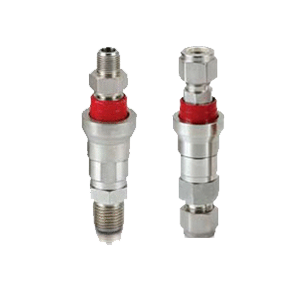
The Superlok® quick connector datasheet covers three series: SHQC for hydraulic service, SQC for instrumentation and SFQC for full flow. For SHQC it states that both socket and plug hold an automatic shutoff valve so the line fluid will not flow out on disconnection. That is a statement about containment after the halves part, not permission to part them under load. For all three series the datasheet publishes coupled working pressures, for example 3000 psig for SQC1 down to 750 psig for SQC3 at 70 °F, and says that components can limit pressure and temperature ranges. It gives no separate limit for making or breaking the connection under pressure and carries no warning about it.
A silent datasheet is not a green light. It means the number does not exist in the document you hold, so the answer has to come from Superlok® sales for the exact series, size, fluid and temperature. Until it does, plan on depressurizing. The wider ratings are collected on the pressure ratings page, and the installation guide covers assembly practice.
Why forcing a coupling under pressure is unsafe
The literature points to several separate hazards. Beswick explains the first: to connect at higher pressures, the user has to overcome the forces acting on the shutoff mechanisms and springs. A user who leans harder on a half that resists is working against stored pressure, not against friction. Parker®’s danger notice names the outcome of misuse as high velocity fluid discharge, and contact with fluids that may be hot, cold, toxic or otherwise injurious. In a sample line that fluid may be a process gas or a corrosive liquid, which is why the choice of a corrosion-resistant 316 stainless steel body is only part of the picture.
Trapped pressure is the quieter hazard. A blocked-in line can hold pressure after the source is closed, and Parker®’s PH page ties residual pressure to thermal expansion. Fluid Power World notes that flat-face designs eliminate the problems of trapped pressure in a line. A Power & Motion Technology report adds that air can be trapped between valves and enter the system on reconnection, and that couplings may see vibration or rotation between the halves while pressurized. Locking is a fourth point: Parker®’s guide warns that ball locking couplings can disconnect unintentionally if the sleeve is bumped.
| Situation | What the sources establish | Practice |
|---|---|---|
| Pressure on one side | Only designs made for it should be connected under pressure (Parker®) | Confirm the series is designed for it |
| Pressure on both sides | No fetched source gives a procedure | Vent both sides, or ask the maker |
| Residual pressure | Thermal expansion can cause it (Parker® PH page) | Vent and confirm zero |
| Open-ended half | Do not uncouple single-end shutoff under pressure (Swagelok®) | Release pressure first |
| Rating unknown | Working pressure may not be safe connect pressure (Parker®) | Treat as unrated |
The practice column is general good practice, not a figure from the cited documents.
A working sequence for instrument lines
The straightforward way to avoid the question is to remove the pressure. Isolate the line at the source, vent the trapped volume and confirm zero before the halves are touched. Our root valve vs isolation valve post explains where isolation belongs, single vs double block and bleed covers proving the isolation, and the bleed valves page lists the hardware that does the venting. For tube-end connections to the coupling, the SQC quick connect bodies catalog page shows what is offered. Superlok® states that its fittings give the finest interior surface finish of any tube and pipe fitting on the market. That describes the bore, and how a coupling handles pressure while it is made up is a separate matter.
Questions on coupling under pressure
Does the coupled pressure rating tell me the safe connection pressure?
No. Parker®’s guide says the rated operating pressure may not be the pressure at which a coupling can be safely connected or disconnected.
Is there a pressure at which Superlok® couplings can be connected?
The datasheet reviewed here does not state one. Ask Superlok® sales with your series, size, fluid and temperature.
Why is an automatic shutoff valve not enough?
It limits fluid loss when halves part. Beswick notes the same valves and springs are what a user must overcome when connecting at higher pressure.
Can a pressure-connect design be used on both halves?
Parker®’s PH page recommends that only one half be the PH version, not both. Follow the maker’s page for the design you hold.
What if the line was closed and still reads pressure?
Treat it as live. Parker®’s PH page links residual pressure to thermal expansion, so vent it through a bleed and confirm zero.
Specifying a coupling for a live line?
Send the series, fluid, pressure and temperature, and we will help you confirm the datasheet position.
SUPERLOK® NORTH AMERICA
Vent first, couple second.
Sources
- Parker®, “Quick Coupling Safety Guide,” Parker® publication DS6013 (undated manufacturer publication). Supports section 2.5 on pressurized connect or disconnect, the danger notice and the ball-lock caution. parker.com
- Parker®, “Connect Under Pressure, Multi-Purpose Quick Couplings, PH Series” product page. Supports the 3000 psi static pressure, one-half-only recommendation, residual pressure from thermal expansion and the added relief feature. ph.parker.com
- Swagelok®, “Quick-Connects, QC, QF, QM, and QTM Series (MS-01-138),” Rev. V, January 2025. Supports the pressure rating restriction and the uncoupling warnings. swagelok.com
- Beswick Engineering, “The Basics of Quick Disconnects” (undated manufacturer publication). Supports leakage during pressurized connection and the difficulty at higher pressures. beswick.com
- Power & Motion Technology, “Making the connection,” staff report, 13 October 2010. Supports trapped air on reconnection and vibration while pressurized. powermotiontech.com
- Mary Gannon, “What are quick-connect couplings?”, Fluid Power World, 31 August 2016. Supports the trapped pressure statement on flat-face designs. fluidpowerworld.com
- Superlok® North America, quick connector datasheet BMT-CQC Rev. 6 (2019), at superloknorthamerica.com/wp-content/uploads/2026/03/. Supports the series list, SHQC shutoff valves, coupled ratings and the component caveat.
Technical note: These sources establish what Parker®, Swagelok® and Beswick publish for their own couplings and what the Superlok® datasheet states for its own series. They do not establish a pressure at which any Superlok® coupling can be connected, and the Parker® figures apply only to that maker’s PH Series. The sequence in the table is general practice. Grade and rating are confirmed per order.
Trademark disclaimer: Superlok®, Parker® and Swagelok® are registered marks of their respective owners. Their use here identifies the products referenced. Cross-references are made by form, fit, and function only.