

SUPERLOK® NORTH AMERICA · VALVES
Sizing an Excess Flow Valve to the Line
How to place the closing flow between what the line normally carries and what a broken line could deliver.
A valve that trips too early shuts a healthy line, and one that trips too late protects nothing, so excess flow valve sizing is a question of placing one number correctly between two others. According to Dormont, a Watts company, in the installation and operation manual for its gas appliance valve (a manufacturer publication, copyright 2025), the instruction reads: “Select the EFV with the lowest Maximum Flow Capacity that is greater than your appliance requirement.” The same logic applies to any line. This guide sets out the method for the excess flow valves in our range, without trip figures we cannot source. Earlier pieces cover natural gas, propane and the internal mechanism.
Excess Flow Valve Sizing: The Window Between Two Flows
Every installation has a floor and a ceiling. The floor is the largest flow the line should ever carry in routine use, including start-up. The ceiling is the flow a broken line would actually pass at the supply pressure available. The closing flow has to sit in the gap.
Manufacturers publish their own guidance on where inside that gap to aim. The Fisher® F Series manual (form MCK-1060, May 2009), written for LP-gas and ammonia valves, suggests choosing a closing flow of 1.5 times the maximum operating flow, and about twice that flow where surges can occur. It also says the closing flow must stay below the capacity of the system the valve protects. These multipliers come from one manufacturer’s product line and fluid service, so compare them with the documentation for whatever valve you specify.
Real valves do not close at exactly the number printed on them. The same Fisher® manual states a closing flow tolerance of plus 10 percent to minus 20 percent of rated flow. Our own arithmetic shows what that does to the window: a 1.5 times selection closes anywhere from 1.2 to 1.65 times maximum operating flow, and a 2 times selection from 1.6 to 2.2 times. For utility service lines, 49 CFR 192.381 sets a similar limit, requiring closure at or not more than 50 percent above the manufacturer’s rated closure flow when tested at 10 psig. Margin must be built on top of the tolerance, not instead of it.
Why Oversizing Defeats the Valve
If the closing flow is higher than the most a ruptured line can pass, the poppet never moves. Dormont’s manual lists this exact case as a condition where its valve cannot provide protection: a rated trip flow higher than the open-ended flow of the piping system. Fisher® makes a related point from the other side. Branching, long runs, extra valves, reduced pipe sizes and elbows all hold flow below the valve’s rating, and in that case the valve will not give excess flow protection.
Small-bore tubing is where this bites. A narrow, long run may deliver far less at a break than a short run of heavier tube, a point worth remembering when you read our guidance on tube wall thickness and pick fittings from the tube fittings range. Check the ceiling with a real flow calculation for your tubing, length and supply pressure. Partial breaks need the same scrutiny: Dormont adds that a downstream break too small to produce open-ended flow will not activate its valve either.
Why Undersizing Causes Nuisance Trips
When the floor and the closing flow are too close, ordinary events shut the line. Fisher® names the symptoms: normal flow too near the closing flow causes chattering, backflow or a wrong flow direction can do the same, and so can a restriction at the valve inlet. It warns that chattering can wear the valve and lead to failure. Dormont notes that opening a supply valve too quickly can trip its valve, which is a start-up surge in miniature.
List every event that moves more fluid than steady running does: filling an empty line, repressurising after a transmitter swap, purge pulses on a sample system, and pump start-up. Our note on check valve sizing by flow works through a similar flow-first approach for another spring-loaded valve. If the largest of these events comes close to the planned closing flow, choose a higher setting and re-check the ceiling, or change how the line is brought up to pressure.
| Trap | What happens | Source |
|---|---|---|
| Normal flow near closing flow | Chattering, wear, possible failure | Fisher® F Series manual |
| Closing flow above open-ended flow | Valve never trips | Dormont manual |
| Restrictions in the protected run | Flow stays below the rating, no protection | Fisher® F Series manual |
| Supply pressure below the trip pressure | Valve cannot be tripped by the line | Swagelok® XS Series instructions |
| Mounting position changed | Rated trip differs by orientation | Dormont manual |
Each row is one manufacturer’s statement about its own valve, not a general law.
A Five-Step Sizing Method
- Write down the fluid, its phase and the supply pressure. Ratings are stated for a phase, so a gas figure says nothing about a liquid line.
- Find the largest normal flow, including start-up and purge events.
- Calculate what the line would pass if broken cleanly at the far end.
- Choose a closing flow above step two with margin for the tolerance, and below step three.
- Confirm the choice by test. Swagelok®, in its XS Series service instructions (MS-CRD-0064, Rev. D, June 2026), requires the valve to stay open at normal flow and at maximum surges, and to trip when the line is vented to simulate a break. If it will not trip, it suggests a lower-flow spring or a smaller valve.
Orientation belongs in the method as well. Dormont’s table lists a different rated trip flow for horizontal, vertical-up and vertical-down mounting of one model, and Fisher® states that its closing flow rating applies to the horizontal position. Make-up practice is in the installation guide.
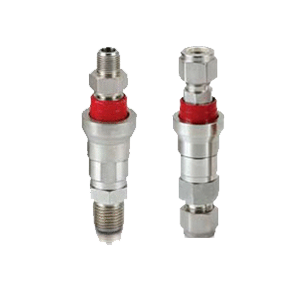
The Superlok® product page gives no trip flows, so we give none, and the closing flow for a Superlok® valve should come from its documentation at order time. Wetted parts are listed in 316 stainless steel, a corrosion-resistant grade, with grade and rating confirmed per order. Compare ratings on the pressure rating page.
Questions on Choosing the Closing Flow
Is a bigger valve always the safer choice?
No. A larger closing flow can sit above anything the broken line passes, and then the valve does nothing.
Why test when the data sheet gives a number?
Tolerance, piping restrictions and supply pressure move the real closing point. A vent test shows what your line does.
Does the Superlok® page list a closing flow?
No, and we state none. Closing flow comes from the valve documentation at order time.
Can the same figure serve a liquid and a gas line?
Not safely. The rating belongs to one phase, so use the number for the fluid in the line.
A sizing calculation only holds if the tubing behaves as drawn, which brings us back to a point we make often.
SUPERLOK® NORTH AMERICA
Held to the finest interior surface finish of any tube and pipe fitting on the market
Sources
- Dormont Manufacturing, a Watts company, “IOM-D-Foodservice EFV 2547” installation and operation manual, 2025 (manufacturer publication): lowest-capacity selection rule, rated trip above open-ended flow, partial breaks, quick opening trips, orientation table. watts.com
- Emerson (Fisher®), “F Series Excess Flow Valves for LP-Gas and Anhydrous Ammonia Instruction Manual,” form MCK-1060, May 2009 (manufacturer publication): 1.5 times and 2 times guidance, tolerance, restrictions, chattering, horizontal rating. emerson.com
- Swagelok®, “XS Series Excess Flow Valve Service Instructions,” MS-CRD-0064 Rev. D, June 2026 (manufacturer publication): open at normal and surge flow, vent test, lower-flow spring or smaller valve, system pressure above trip pressure. swagelok.com
- U.S. Government, “49 CFR 192.381 Service lines: Excess flow valve performance standards,” as published by Cornell Law School’s Legal Information Institute: closure at or not more than 50 percent above rated closure flow at 10 psig. law.cornell.edu
- Superlok North America, “Excess Flow Valves” product page (manufacturer publication): no sizes or trip flows are given. superloknorthamerica.com
Technical note: The sources establish how three manufacturers and one federal utility rule describe selecting, testing and tolerancing closing flow for their own valves. The multipliers are one maker’s rule for LP-gas and ammonia, not a standard, and the window arithmetic is ours. They do not establish trip flows, pressure ratings or sizing data for any Superlok® product. Material grade and pressure rating are confirmed per order.
Trademark disclaimer: Superlok® is a registered mark of its owner. Fisher® and Swagelok® are registered marks of their respective owners. Emerson, Dormont, Watts and Cornell Law School are named only to identify sources. Cross-references are made by form, fit, and function only.