

SUPERLOK® NORTH AMERICA · VALVES
How an Excess Flow Valve Works, Step by Step
Spring, poppet, pressure drop, bleed passage and reset, followed in the order they happen when a line breaks.
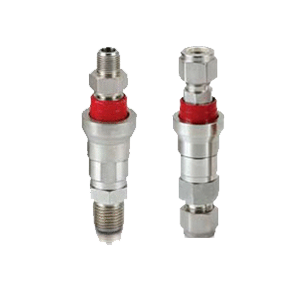
A sheared tube on a pressurised line can empty the supply side in moments, and nobody has to be standing nearby for the valve to react. According to the Fisher® F Series instruction manual (form MCK-1060, May 2009), published by the manufacturer for LP-gas and ammonia service, an excess flow check valve closes when flow exceeds its rated capacity, then reopens when pressure on both sides of the poppet is equal. This article explains how an excess flow valve works, one stage at a time, using the same mechanism found in the excess flow valves from Superlok®. For service-specific detail see our pieces on natural gas lines and propane containers.
How an Excess Flow Valve Works Inside the Body
Nothing in the device is electrical, pneumatic or operator-driven. Three internal features do all the work, and the sequence below follows them from the idle state to the restored state.
- Idle. A spring pushes the poppet away from its seat, leaving a path through the body. The Superlok® product page lists spring-loaded actuation and a two-piece body that gives access to the springs and seals.
- Flow builds. Fluid squeezing past the poppet loses some pressure on the way through, so the pressure on the inlet side runs a little higher than on the outlet side. The faster the flow, the bigger that difference. The Fisher® manual’s rating table pairs each closing flow with a differential pressure, so differential pressure is part of how the rating is expressed. The cause-and-effect wording here is our plain-language explanation, not a quotation.
- Trip. When the pressure difference acting on the poppet outweighs the spring, the poppet travels to the seat. The Superlok® page puts it this way: “When flow reaches the predetermined rate the poppet will trip, limiting or stopping flow.” Trip is simply the word for that closure.
- Held shut. After a break, the downstream side is open to atmosphere or a low-pressure space while the upstream side stays pressurised. That imbalance presses the poppet onto its seat. A 1973 nuclear plant test report from the U.S. Nuclear Regulatory Commission archive says the same for the spring-loaded slug in its instrument-line valves: during a line break the pressure differential holds the slug closed.
- Bleed. A small passage lets a trickle past the closed poppet. Swagelok® refers to a bleed passage in its XS Series service instructions, and Dormont, a Watts company, says its appliance valve has a bypass that allows gas flow even when tripped.
- Reset. Once the cause of the over-flow is gone, the trickle equalizes pressure across the poppet and the spring walks it back open. The Superlok® page describes automatic reset through a bleed vent with no manual intervention.
The Bleed Passage: Why a Tripped Valve Still Leaks
The bleed gives the design its two-sided character. Without it a closed poppet could stay pinned shut by the very pressure difference that closed it. With it the valve can recover on its own, but it can never be a tight shutoff. The Fisher® manual warns that leakage through the equalizing hole must be controlled or a hazard can result.
Regulators set limits on how much. For gas distribution service lines running continuously at 10 psig or higher, 49 CFR 192.381 requires a valve that equalizes to drop to no more than 5 percent of the manufacturer’s specified closure flow rate, capped at 20 cubic feet per hour, after it closes. It sets a far lower ceiling, 0.4 cubic feet per hour, for a design that prevents equalization. That rule governs utility service lines, not instrument tubing, and we quote it only to show how a bleed is judged. One manufacturer’s gas appliance valve, from Dormont, lists a maximum bypass rate of 2.5 SCFH at 0.5 psi; that figure belongs to that product alone.
| Part | Job | Failure described in the sources |
|---|---|---|
| Spring | Sets how much flow it takes to close the valve | Swagelok® advises fitting a lower-flow spring if a test shows the valve will not trip |
| Poppet | Moves onto the seat and blocks the path | Fisher® lists debris such as pipe scale or welding slag holding it open |
| Bleed passage | Equalizes pressure so the valve can reset | The NRC test report says a valve with zero leakage may not reset |
The sources describe different valve designs; the table shows the common logic, not one product.
What a Trip Does, and What It Cannot Catch
A trip limits flow to the bleed rate. It does not isolate the line, so keep a manual shutoff in the design; our note on root valve vs isolation valve covers where those sit. A trip also needs genuine over-flow. Dormont’s installation notice lists conditions in which its valve will not activate: a partial downstream break too small to produce open-ended flow, a downstream manual valve left only partly open, or a rated trip flow higher than the open-ended flow of the piping. In each case the valve is doing what it was built to do, and the break has not met its threshold.
The same spring logic appears elsewhere in the range. A check valve also relies on a spring and a differential, but it acts on reverse flow or a set cracking pressure, as explained in check valve cracking pressure. For valves that hold a line to a stated pressure rather than a flow, see the relief valves.
For material, the Superlok® page states stainless steel construction and cites durability and corrosion resistance. We list 316 stainless steel as a corrosion-resistant choice for wetted parts, and grade and rating are confirmed per order. Pressure limits by size are on the pressure rating page.
Questions on How the Mechanism Behaves
Does the valve need power or a signal to close?
No. The spring and the flow itself do the work, which is why the mechanism suits remote tubing runs.
Why would a valve not reopen after the repair?
It needs pressure to equalize across the poppet. A downstream valve left open, or a break that is still passing gas, keeps the difference alive. The Fisher® manual suggests closing a shutoff valve and waiting for the valve to click open.
Does a tripped valve work as a closed block valve?
No. The bleed keeps passing a small flow, so use a manual valve when the job is isolation.
Where are the Superlok® trip flows?
Our product page gives no trip flow, size or pressure figures, and we state none here. Send your line details through the quote form.
Need the mechanism matched to a tubing run?
Tell us the line size, supply pressure and fluid.
Inside the valve and around it, the bore is what we keep returning to.
SUPERLOK® NORTH AMERICA
Connections built to the finest interior surface finish of any tube and pipe fitting on the market
Sources
- Emerson (Fisher®), “F Series Excess Flow Valves for LP-Gas and Anhydrous Ammonia Instruction Manual,” form MCK-1060, May 2009 (manufacturer publication): closes above rated flow, equalizing passage, reset, leakage warning, debris. emerson.com
- Swagelok®, “XS Series Excess Flow Valve Service Instructions,” MS-CRD-0064 Rev. D, June 2026 (manufacturer publication): poppet and spring, bleed passage, lower-flow spring remedy. swagelok.com
- Dormont Manufacturing, a Watts company, “IOM-D-Foodservice EFV 2547” installation and operation manual, 2025 (manufacturer publication): bypass when tripped, 2.5 SCFH at 0.5 psi, 60 second reset, conditions where it will not trip. watts.com
- U.S. Government, “49 CFR 192.381 Service lines: Excess flow valve performance standards,” as published by Cornell Law School’s Legal Information Institute: 5 percent and 20 cfh post-closure limits, 0.4 cfh limit for non-equalizing designs. law.cornell.edu
- Northern States Power Company, “Report on Instrument Line Excess Flow Check Valve Test Program,” July 27, 1973, hosted by the U.S. Nuclear Regulatory Commission: differential holds the valve closed, leakage needed for reset. nrc.gov
- Superlok North America, “Excess Flow Valves” product page (manufacturer publication): spring-loaded actuation, two-piece body, bleed-vent reset, stainless steel construction. superloknorthamerica.com
Technical note: The sources establish how spring-loaded flow-tripped valves from several makers, a federal utility rule and a 1973 nuclear plant test report describe closing, bleed and reset. The Dormont figures belong to one appliance valve. The sources do not establish trip flows, bleed rates, pressure ratings or approvals for any Superlok® product, and the pressure-drop explanation in step two is ours. Material grade and pressure rating are confirmed per order.
Trademark disclaimer: Superlok® is a registered mark of its owner. Fisher® and Swagelok® are registered marks of their respective owners. Emerson, Dormont, Watts and NRC are named only to identify sources. Cross-references are made by form, fit, and function only.