

SUPERLOK® NORTH AMERICA · VALVES
Excess Flow Valves on Natural Gas Service
What a flow-tripped valve does on gas lines, where the federal service-line rule stops, and where industrial instrument lines pick up.
Natural gas supply keeps growing, and every pressurised line that carries it is a place where a severed tube can become a release. According to the U.S. Energy Information Administration’s October 2026 Short-Term Energy Outlook, issued on 6 October 2026, U.S. marketed natural gas production is forecast at 123.5 Bcf/d in 2026 and 128.0 Bcf/d in 2027, about 3.6 percent higher. This guide covers the excess flow valve on natural gas service: how the trip mechanism behaves, why the federal rule in 49 CFR 192.383 is a separate subject, and where the excess flow valves made by Superlok® belong in industrial instrument lines, sample lines and gas trains.
How a Flow-Tripped Valve Behaves on a Gas Line
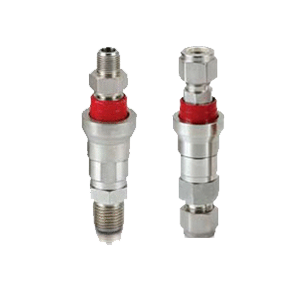
The device is passive. A spring holds a poppet open while gas moves at ordinary rates. If flow rises past the rated trip point, the poppet closes, limiting or stopping flow downstream. According to the Superlok North America excess flow valve page, which is a manufacturer publication, the valve shuts off when flow exceeds a predetermined rate and the poppet resets to open when pressure is equalised across it. PHMSA’s October 2016 final rule describes the same behaviour: a spring keeps the valve open in normal use, it trips on a significant increase in flow, and it resets once the correct pressure is restored.
Two points follow. First, the valve answers to flow, not to the mere presence of a leak. A leak that passes less gas than the trip rate never closes it, and PHMSA’s FAQ says these valves are meant for major damage, not leaks in customer piping. Second, resetting needs pressure to equalise across the poppet, so the design must let a little gas by. A 1973 instrument-line test report filed by a utility with the Atomic Energy Commission, now hosted by the U.S. Nuclear Regulatory Commission, required some leakage in the checked condition so the valves could reset. Of 74 valves tested, seven showed zero leakage and did not reset. That is an old nuclear-plant data point, not a rating for any current product, but it shows why reset matters.
What 49 CFR 192.383 Covers, and What It Leaves Alone
The federal requirement is written for gas distribution operators, not plant instrument tubing. As published on eCFR, 49 CFR 192.383 directs an operator to install a valve on a new or replaced service line before activation in these cases:
- a single service line to one single-family residence;
- certain branched lines to single-family residences;
- a multifamily residence with a known load of 1,000 SCFH or less per service;
- a single small commercial customer with a known load of 1,000 SCFH or less.
The section applies after April 14, 2017. It allows exceptions where the line does not operate at 10 psig or greater throughout the year, where known contaminants could interfere with the valve, where the valve could interfere with necessary operation or maintenance, and where no valve meeting the performance standards in 192.381 is commercially available. PHMSA’s FAQ adds that existing lines need not be retrofitted, and that the valve goes as near as practical to the fitting connecting the service line to the main.
That is a utility product category with its own performance standards. Superlok® excess flow valves are instrumentation and industrial line products. We do not claim they satisfy 192.381 or 192.383; an operator buying for service lines should specify valves that carry that compliance in their own documentation.
| Line | Job of the valve | What stays with the designer |
|---|---|---|
| Utility service line | Required by 192.383 in the listed cases | The operator’s compliance program and approved product list |
| Instrument or impulse line | Limits release if the tube is sheared downstream of the root valve | Whether a break would really flow enough gas to trip it |
| Sample line to an analyzer | Protects a small-bore run that crosses a walkway or a skid edge | Whether purge pulses and sample conditioning flow stay below the trip point |
| Burner or gas train branch | Limits release from a ruptured branch | It does not replace the safety shutoff valves your code requires |
Rows two to four are design guidance, not rule requirements.
Excess Flow Valve Natural Gas Use in Instrument Lines, Sample Lines and Gas Trains
Inside a plant, ask whether a failed tube will pass enough gas to close the valve, and whether the valve stays open through every normal condition. Work both sides with real numbers.
On an instrument line, fit the valve close to the process tap so it covers the longest run of tubing, the reasoning PHMSA gives for service lines. Place it after the root valve so you can still isolate the branch, as our note on root valve vs isolation valve explains. The trip flow must sit above normal flow, including start-up fill and repressurisation after a transmitter swap, or you get nuisance closures. If it sits above what a sheared small-bore tube could ever pass at your supply pressure, it never trips.
On a sample line, analyzer purge and flush cycles can trip a valve sized only for steady flow, so check them first. Our guide to analyzer sample system fittings covers the tubing around such runs, and the oil and gas instrumentation note gives the field context.
On a gas train, treat the valve as one layer. It does not replace the safety shutoff valves, combustion safeguards or leak testing that the applicable code and your burner manufacturer require.
For material, 316 stainless steel suits a corrosion-resistant body where the atmosphere or washdown regime demands one; confirm service conditions such as hydrogen sulfide before settling the grade, using our comparison of 316 vs 316L. Grade is listed in 316 stainless steel and confirmed per order. For threaded ends see NPT thread sealant, and pair the valve with tube fittings and needle valves at the isolation points. Ratings are on the pressure rating page and make-up practice is in the installation guide.
Questions From Gas Instrument Designers
Does a flow-trip valve take the place of a manual shutoff on a gas line?
No. It closes on flow and will not isolate a line for maintenance. Keep the root or isolation valve you would have fitted anyway.
Do Superlok® valves satisfy the PHMSA residential service-line rule?
We make no such claim. The rule sits with distribution operators and points to standards in 192.381; our valves are instrumentation and industrial line products.
Why would a tripped valve stay shut after the repair?
Reset needs pressure to equalise across the poppet. Keep the downstream valve closed until it has, then reopen slowly.
What body material should I list for outdoor gas service?
Tell us the site conditions. We list 316 stainless steel, and grade and rating are confirmed per order.
Sizing a flow-trip valve for a gas line?
Send tube size, supply pressure and normal flow.
One line sums up how we build the connections around these valves.
SUPERLOK® NORTH AMERICA
Engineered around the finest interior surface finish of any tube and pipe fitting on the market
Sources
- U.S. Energy Information Administration, “Short-Term Energy Outlook, October 2026” (forecast release 6 October 2026) and Table 5a, marketed natural gas production of 123.5 Bcf/d in 2026 and 128.0 Bcf/d in 2027. eia.gov
- U.S. Government, “49 CFR 192.383 Excess flow valve installation,” eCFR, scope, cases, April 14, 2017 date and exceptions. ecfr.gov
- PHMSA, Federal Register Vol. 81, No. 199, October 14, 2016, final rule on excess flow valves in gas distribution, spring-held operation, trip and automatic reset. govinfo.gov
- PHMSA, “Distribution Integrity Management Frequently Asked Questions” (2015), purpose of the valve, new or replaced lines only, location, 10 psig exemption. phmsa.dot.gov
- Northern States Power Company, “Report on Instrument Line Excess Flow Check Valve Test Program,” July 27, 1973, filed with the U.S. Atomic Energy Commission (Monticello plant) and hosted by the U.S. Nuclear Regulatory Commission, leakage needed for reset and 74-valve test result. nrc.gov
- Superlok North America, “Excess Flow Valves” product page (manufacturer publication), predetermined-rate shutoff and pressure-equalised reset. superloknorthamerica.com
Technical note: The sources establish the rule text for utility service lines, the general trip and reset behaviour of a spring-loaded flow-tripped valve, and the EIA production forecast. They do not establish trip flows, pressure ratings, sizing or approvals for any Superlok® product, nor do they show that an instrument-line valve suits your service; the 1973 report concerns a nuclear plant, not current products. Check the current text of the rule before relying on it. Material grade and pressure rating are confirmed per order.
Trademark disclaimer: Superlok® is a registered mark of its owner. Other organisation and standard names, including EIA, PHMSA and eCFR, are used only to identify the sources cited. Cross-references are made by form, fit, and function only.