
SUPERLOK® NORTH AMERICA · VALVE ENGINEERING
Lubricated vs Non-Lubricated Plug Valves
What the sealant does, what a sleeve or O-ring does instead, and what each design asks of the maintenance crew.
The phrase lubricated plug valve sounds like a valve that is oiled so it turns easily, and that is not quite what it means. According to Supply House Times, a trade publication, the word describes a means of sealing the plug against leakage: grooves in the plug are filled with a thick lubricant that seals the gap to the body. Designs without that sealant are called non-lubricated. If you are comparing the whole family before you narrow to one design, start at our plug valves page, then come back here for the sealing question.
How a lubricated plug valve seals
Projectmaterials, an engineering reference by its editorial team, describes the lubricated type as a tapered plug in a matching tapered cavity. Sealant is injected through a check valve and grease fitting on the top of the valve, and it fills the space between plug and body, giving both sealing and corrosion protection.
The sealant also does a second job. Valve Magazine, published by the Valve Manufacturers Association, carries an article by Greg Johnson of United Valve (21 June 2017). It says that when the valve is closed only a thin film of lubricant separates plug from seat, and that a squirt of very high pressure lubricant moves the plug slightly off the seat so it turns easily through 90 degrees. In this design the sealant is part of the mechanism, not an accessory. The same article states that lubricated plug valves must have lubrication to operate.
The non-lubricated alternatives
Supply House Times describes two non-lubricated approaches. One lets the plug wedge into its mating cavity when turned to the closed position and lifts it slightly when turned open, to relieve binding. The other uses an elastomeric sleeve around the plug, or a resilient material on the plug surface. The article also says non-lubricated designs typically use O-rings in place of the sealant.
Projectmaterials defines the sleeved version as a polymeric sleeve of PTFE, PFA or another fluoropolymer between plug and body. In its words, the sleeve provides sealing and low-friction operation without the need for sealant injection. That removes the grease gun from the maintenance plan, but it ties the temperature limit to the sleeve material instead of the sealant.
| Factor | Lubricated | Non-lubricated (sleeved) |
|---|---|---|
| Seal | Sealant injected between plug and body | Polymeric sleeve between plug and body |
| Upkeep | Regular re-lubrication; without it the plug can seize | Listed as low maintenance, no sealant injection |
| Temperature | Up to 350°C depending on the sealant | Up to 200°C for PTFE, 260°C for special liners |
| Typical service | Pipeline block valves in crude oil and natural gas gathering | Chemical and pharmaceutical plants, where sealant contamination is unacceptable |
Temperature figures are the reference site’s general ranges for each family, not ratings for any one valve.
Lubricant selection and upkeep
Because the sealant stays in contact with the process fluid, it has to suit that fluid. The Valve Magazine article cites API 599, which calls for a hydrocarbon-resistant lubricating sealant unless the purchase order says otherwise, with a sealant range of -20°F to 225°F (-23°C to 107°C). It adds that most injectable lubricants are petroleum-based and therefore limited to hydrocarbon service, and that oxygen service cannot tolerate petroleum-based lubricants. A few compounds are formulated for oxygen and chlorine duty.
For upkeep, the practical rules from the sources are short. Keep to the re-lubrication schedule, because a neglected schedule can seize the plug. Use the sealant the manufacturer names for your fluid. Treat the grease fitting as a maintenance point in the plant records, as you would a packing adjustment. None of the pages we reviewed gives a universal injection interval, so the interval comes from the valve maker, not from a rule of thumb.
Where each design is used
Projectmaterials says lubricated plug valves are standard for pipeline block valves in crude oil and natural gas gathering systems, and it cites waxy crude, sand-laden fluids and high-pressure gas among the services. It says non-lubricated designs are preferred where sealant contamination cannot be accepted, naming chemical plants and pharmaceutical facilities. For process plant context, see our posts on chemical processing fittings and oil and gas instrumentation fittings.
Supply House Times adds the limit that applies to both families: plug valves are not usually recommended for throttling and are intended mainly for on-off service.
What the Superlok® catalog states
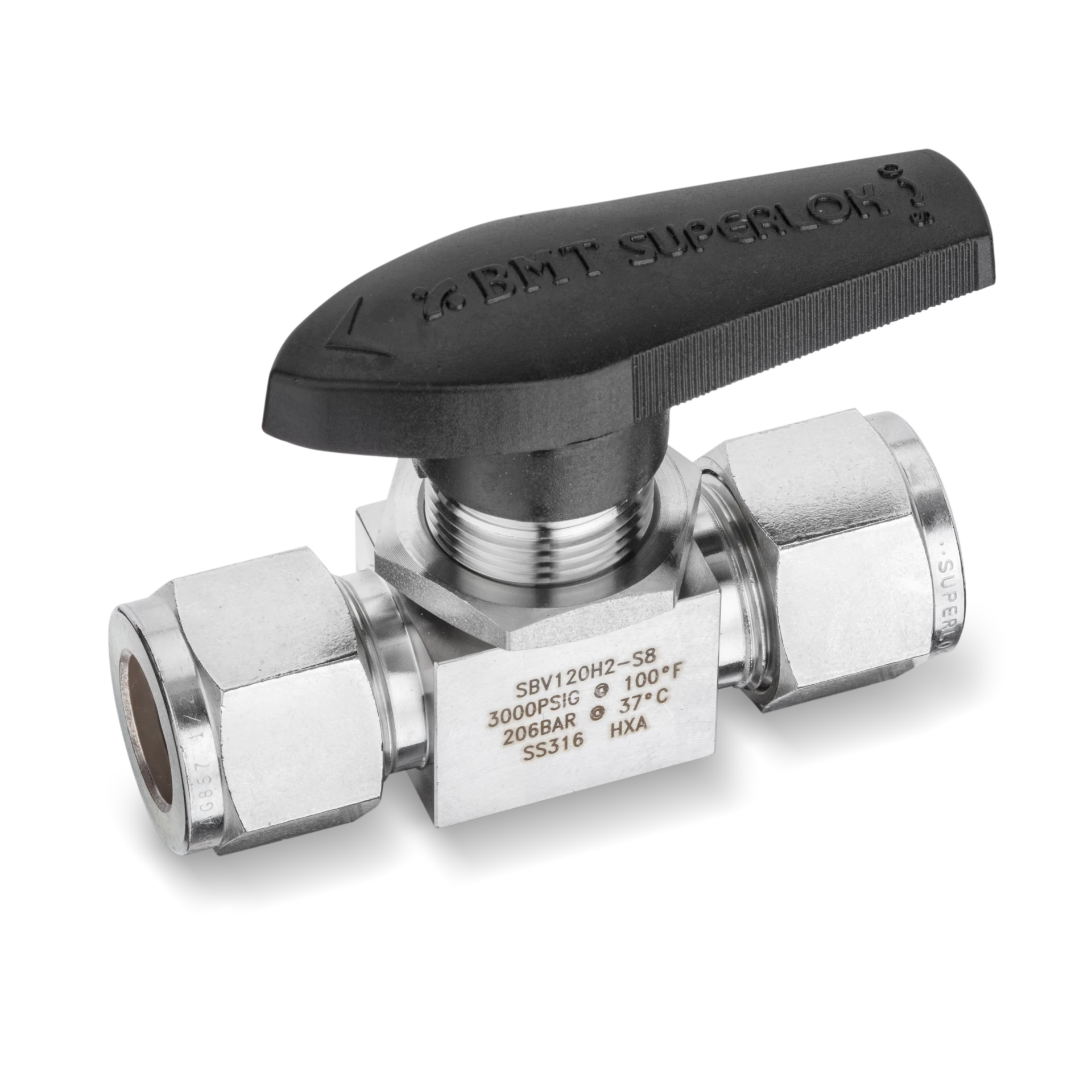
We will describe the catalog and leave the classification to the data. The SPV plug valves page lists a one-piece body in 316 stainless steel, a corrosion-resistant grade, with a rating of 3000 psig (206 bar) at 100°F and an operating range of -10°F to 400°F. The SPV130 series datasheet lists a PTFE-coated 316 plug and PTFE-coated fluorocarbon O-rings, and an aluminum handle. Neither the page nor the datasheet uses the words lubricated or non-lubricated, and neither describes a sealant fitting. We therefore do not place the SPV in either category here. If your specification requires one, ask for the construction in writing before you order.
The rising series is a separate design, listed with an acetal seat. Its catalog entry is on the SRPV rising plug valves page. For the earlier comparison of plug and ball designs, read our plug valve vs ball valve post. Whatever the sealing type, confirm the rating at your operating temperature on the pressure rating page.
Questions on sealing and upkeep
Does lubricated mean oiled for easy turning?
Not primarily. Supply House Times says the term refers to a means of sealing the plug. Valve Magazine adds that the lubricant also frees the plug to turn, so it does both jobs.
What happens if re-lubrication is skipped?
Projectmaterials says the plug can seize without regular re-lubrication.
Can any sealant go in any lubricated valve?
No. Valve Magazine says most injectable lubricants are petroleum-based, which limits them to hydrocarbon service, and that oxygen service cannot use them.
Is the Superlok® SPV lubricated or non-lubricated?
The catalog page and datasheet we reviewed do not say. They state a PTFE-coated plug and fluorocarbon O-rings, so ask for the construction details at the quote stage.
Name the fluid, we will check the seal
Send the media, pressure and temperature and we will return the catalog data for the valve.
SUPERLOK® NORTH AMERICA
When the run continues in tubing, Superlok® fittings offer the finest interior surface finish of any tube and pipe fitting on the market.
Sources
- Supply House Times (BNP Media), “College of Product Knowledge: General Application Valves Part III,” 1 December 2002 (trade press). Supports the meaning of lubricated, grooves and sealant, the wedging and sleeve designs, O-rings, and the on-off service comment. supplyht.com
- Projectmaterials, Editorial Team, “What Is a Plug Valve?,” published 29 February 2024, modified 30 September 2026 (engineering reference). Supports sealant injection, sleeve materials, maintenance, temperature ranges and typical services. blog.projectmaterials.com
- Greg Johnson, United Valve, “Lubricants: Always Important, Sometimes Essential,” Valve Magazine (Valve Manufacturers Association), 21 June 2017 (trade association publication). Supports lubricant function, API 599 sealant requirements and range, and fluid compatibility. valvemagazine.com
- Superlok® North America, SPV plug valves catalog page and SPV130 series datasheet (manufacturer publications). Support the body material, rating, temperature range, PTFE-coated plug and fluorocarbon O-rings. superloknorthamerica.com
Technical note: the sources establish how lubricated and non-lubricated plug valves are generally described and the sealant requirements cited from API 599. They do not establish an injection interval, the sealing category of any Superlok® valve, or the sealant or sleeve behavior for a specific fluid. The temperature ranges are general figures for each family. The Valve Magazine article is written from the viewpoint of United Valve. The 2002 trade article predates current designs. Grade and rating confirmed per order.
Trademark disclaimer: Superlok® is a registered mark of its owner. Supply House Times, Projectmaterials, Valve Magazine, the Valve Manufacturers Association, United Valve and API are names of their respective owners, used only to identify sources, with no affiliation implied. Cross-references are made by form, fit, and function only.