

SUPERLOK® NORTH AMERICA · VALVE ENGINEERING
Rising Plug Valves and Where They Fit
How lifting the plug changes torque and seat wear, and what the Superlok® SRPV catalog page states about its rising series.
A rising plug valve solves a specific problem in a quarter-turn shutoff: the tapered plug drags against its seat every time it turns. According to US Patent 3,948,284, a patent record assigned to the Dow Chemical Company and issued on 6 April 1976, the rising-plug design lifts the plug off its seat so it turns with little effort, then forces it back into the seat. This post covers that mechanism and the Superlok® SRPV series. For the wider family, see our plug valves page.
How a rising plug valve works
In a conventional tapered plug, closing wedges the plug into the body, and turning it means dragging it across that seating surface. Supply House Times, a trade publication, notes that one non-lubricated design is made to lift slightly when turned open, to relieve binding. The rising plug takes that idea further: lift first, rotate second, reseat last.
A second patent record shows the same sequence in a different build. US Patent 4,597,560, a half-turn valve filed in 1985 by Conval, describes a stem whose threaded end jacks the plug away from the seating ring, after which the stem rotates the plug. Its stated aim is lifting and rotating in a single continuous action while keeping the plug tightly seated when closed. The two patents differ in detail, which is a reminder that “rising plug” names a principle, not one fixed construction. The mechanism inside a given valve comes from that valve’s own documentation.
Why lift the plug: torque and seat wear
The Dow patent states that plug valves were long favored for shutoff, but larger sizes often needed more torque to operate, and that lifting the plug was the answer. Wear is the second motive. The Conval patent calls wear of moving parts a major concern in rotary plug valves, especially when high pressure loads the plug, and says moving the plug away from its seat before turning it is a known way to reduce that wear.
The Dow patent also records a limit. The narrow end of the plug suffers heavy abrasion, and particulate matter collects in the cavity at that end, where it can wear the sealing surfaces and eventually stop the plug seating. The patent says its own flushing design does not solve all problems with particulate solids and is most useful where small amounts of solids are present. So lifting reduces friction, but it does not remove the effect of solids.
For a comparison with ball designs, which is how many instrument designers first meet this valve type, read plug valve vs ball valve for instrument service.
What the SRPV catalog page states
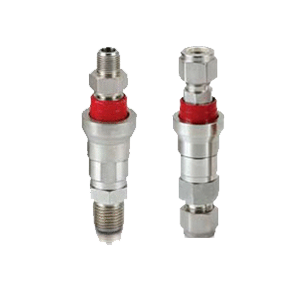
The SRPV rising plug valves page lists four models in female NPT and male by female NPT ends: 1/4 inch and 1/2 inch female NPT, and a 1/2 inch male by female model offered in a standard and a NACE-rated version. It describes a straight-through flow path and a body of corrosion-resistant stainless steel. Every model carries an acetal seat, and a fluorocarbon stem seal is listed on two of them, with a fluorocarbon temperature rating of -20°F to 400°F. Two models list a Cv of 1.8 and a 6.4 mm orifice; dimension and Cv fields are blank on the others, so request them per part number.
The page also says the stem is non-rotating, which it states prevents wear on the sealing surface and extends service life. That is the manufacturer’s own account of the wear benefit, and we give it as stated. The page does not describe the lift sequence, name a plug material, or say whether the design is lubricated, so we do not describe those here. Our post on lubricated vs non-lubricated plug valves sets out why that last question matters.
Read the rating at your temperature
The catalog page labels its three pressure ratings as acetal-seat ratings. They step down sharply as the line warms, so the headline figure is only the starting point.
| Temperature | Rating | Share of top rating |
|---|---|---|
| -20°F to 100°F (-28°C to 37°C) | 6000 psig (413 bar) | 100% |
| 200°F (93°C) | 2650 psig (182 bar) | about 44% |
| 250°F (121°C) | 1000 psig (68.9 bar) | about 17% |
The share column is our arithmetic from the three catalog figures. Confirm the rating for your temperature against the pressure rating page and per order.
A sample line at 200°F therefore needs a valve judged against 2650 psig, not 6000. Give the maximum pressure and maximum temperature together when you ask for a recommendation.
Where the rising design fits
The catalog page lists oil and gas, petrochemical and industrial process applications, and one model is listed as NACE rated. In our judgment, the case for a rising design over a standard tapered plug is high line pressure combined with frequent operation, where torque and seat wear count. For lower pressure, the one-piece SPV plug valves are rated 3000 psig at 100°F per their catalog page.
One caution on flow control. The SRPV page describes the valve as engineered for precision flow control, but Supply House Times says plug valves are not usually recommended for throttling and are intended mainly for on-off service. If you plan to hold the valve part open, ask Superlok® engineering to confirm that duty in writing. For metering, a needle valve is the usual choice, as we explain in needle valve vs ball valve.
Questions on rising designs
Why does lifting the plug cut torque?
The Dow patent says the plug is lifted off its seat so it turns with little effort, then forced back into the seat to seal.
What seat does the SRPV use?
The catalog page lists an acetal seat on every model, with ratings labeled for acetal.
What is the SRPV rating at 250°F?
The catalog page gives 1000 psig (68.9 bar) at 250°F, against 6000 psig from -20°F to 100°F.
Does the stem rotate?
The page describes a non-rotating stem and says it prevents wear on the sealing surface.
Give us the pressure and the temperature
We will return the SRPV data that fits the duty, or say where it does not.
SUPERLOK® NORTH AMERICA
Past the valve, the tubing connects with the finest interior surface finish of any tube and pipe fitting on the market.
Sources
- US Patent 3,948,284, “Rising-plug plug valve,” inventor Charles Joseph Walworth, assignee The Dow Chemical Company, issued 6 April 1976 (patent record, industrial assignee). Supports the lift-then-reseat mechanism, the torque motive, and the abrasion and particulate limits. patents.justia.com
- US Patent 4,597,560, “Half-turn valve,” Conval, Inc., filed September 1985 (patent record, industrial assignee). Supports the jacking of the plug off its seat before rotation and the wear motive. patents.google.com
- Supply House Times (BNP Media), “College of Product Knowledge: General Application Valves Part III,” 1 December 2002 (trade press). Supports the lift to relieve binding and the throttling comment. supplyht.com
- Superlok® North America, SRPV rising plug valves catalog page (manufacturer publication). Supports models, seat, stem seal, ratings, non-rotating stem and applications. superloknorthamerica.com
- Superlok® North America, SPV plug valves catalog page (manufacturer publication). Supports the SPV 3000 psig rating. superloknorthamerica.com
Technical note: the patents establish the rising-plug principle and its stated motives from the inventors’ own descriptions, and are decades old; the Supply House Times article dates from 2002. The SRPV catalog page establishes ratings, seat, stem seal and the non-rotating stem as the manufacturer states them. It does not establish the lift sequence inside the SRPV, plug material, lubrication, torque values, or suitability for throttling, and some model fields are blank. The fit section is our judgment. Grade and rating confirmed per order.
Trademark disclaimer: Superlok® is a registered mark of its owner. Dow Chemical, Conval, Supply House Times and NACE are names of their respective owners, used only to identify sources, with no affiliation implied. Cross-references are made by form, fit, and function only.